Best Crypto Apps & Exchanges for Beginners in 2023
Summary
The post Best Crypto Apps & Exchanges for Beginners in 2023 appeared first on Coinpedia Fintech News Cryptocurrencies have been gaining popularity in India, attracting many investors intrigued by digital assets’ potential. The Indian government’s acknowledgement of cryptocurrency income has contributed to this trend, lending it more credibility. Crypto apps in India have emerged as the preferred platform for investing in crypto in India, highlighting the need for user-friendly and seamless experiences. According to Statista’s market forecasts, the number of crypto users in India is expected to grow significantly by 2027. Factors such as India’s smartphone user base, the push towards a cashless economy, and the influence of FinTech contribute to the rising adoption of cryptocurrencies. This article will help you evaluate and choose the best crypto apps to begin your crypto journey with. Factors to Consider when Choosing Crypto Apps to Invest When selecting a crypto app, beginners should consider several key factors to ensure a smooth and secure investment experience: a) Security: Strong security measures are paramount to protect users’ funds. Look for apps that implement features like two-factor authentication (2FA) and encrypt information about user accounts and transactions. b) User Interface: A beginner-friendly interface is essential, as it simplifies the trading and investment process. You should ideally look for crypto apps with intuitive navigation, clear instructions, and an organized layout. c) Supported Cryptocurrencies: The ideal crypto application will provide beginners with diverse investment opportunities and the flexibility to explore different digital assets as their understanding of the industry grows. d) Fees and Charges: Transparent fee structures and low transaction costs are important considerations. High fees reduce investment returns, so users should choose apps that offer competitive and clearly defined fee schedules. e) Customer Support: Reliable customer support is vital, particularly for beginners who may have questions or require assistance. Look for crypto apps that provide responsive and knowledgeable customer support channels, including an expanding knowledge base to address concerns and find answers. These factors should ideally be considered when choosing the best crypto app to invest in. Top 5 Crypto Apps in India for Beginners in 2023 Mudrex Mudrex is the best cryptocurrency app for beginners to invest in crypto and has over 1 million active users. This crypto app lets you buy from over 100+ crypto coins and invest in thematic crypto-baskets called Coin Sets. The platform also allows investors to invest in Coin Sets regularly through its SIP feature. Investors can generate 10% interest by parking their money in Vault. The app lets users deposit INR or crypto for investing through various payment methods, including UPI and bank transfers. Security:2 Factor Authentication with Bank grade security, funds insured by Lloyds,UI: Intuitive and Easy to use Fees: 0.2% on transactionsSupported cryptocurrencies: 100+ Coins supportedMinimum investment: $5 Support: Chat, email, knowledge base on app Coinbase Coinbase was launched in 2012 and has a global presence. The platform lets users buy, sell, and store more than 250 cryptocurrencies, NFTs, and other wallets in one place. It makes cryptocurrency transactions easy and enables users to store all their digital assets in one place. The platform offers different products for individuals, businesses, and developers.Security: 2 step-verificationUI: Easy to use Fees: 2% on all transactionsSupported cryptocurrencies: 250+Minimum investment: $2 Support: phone support, live chat support, and email CoinSwitch CoinSwitch is an Indian crypto exchange with over 11 million users. The platform lets users deposit INR to purchase cryptocurrencies and even trade cryptocurrencies for cryptocurrencies. It requires a quick KYC before starting transactions. Beginners can easily deposit INR and start buying and selling crypto. The platform also lets users purchase crypto regularly through SIPs. Security: SSL/TSL and KYCUI: Easy to use Fees: 0.1% on all transactionsSupported cryptocurrencies: 100+ coinsMinimum investment: Rs 100 Support: in-app, email, knowledge base WazirX WazirX is a popular crypto exchange in India with over 13 million users. The beginner-friendly app lets users buy and sell cryptocurrencies at the lowest prices. It also operates a P2P converter for quickly converting INR to cryptocurrencies. Users can deposit money through UPI or IMPS to begin trading. Security: 2-Factor AuthenticationUI: Intuitive and Easy to use Fees: 0.2% each on buy and sell transactionsSupported cryptocurrencies: 250+Minimum investment: Rs 100 Support: Chat, knowledge base, youtube. Binance Binance is the best cryptocurrency exchange in India. Based on expertise and subject knowledge, Binance’s app lets users decide whether to run the lite or the pro version. Binance enables beginners to set up price alerts to get the best deals and allows recurring purchases of cryptocurrencies. The app lets users spend their Bitcoin and BNB using a Binance card at select markets. Users can even earn interest on their crypto by using Binance. Security: SAFU and 2FAUI: Intuitive and Easy to use Fees: 0.1%/0.1% on buy and sell transactionsSupported cryptocurrencies: 150+Minimum investment: Rs 100 Support: Chat, FAQ Tips for new crypto investors: Starting small and experimenting with modest investments is always good before topping up your stakes. Trading may not suit all users. However, investing is for everyone. Stay updated on the latest news and DYOR: Do your own research before investing or trading in cryptocurrencies. Diversify your holdings to even out risks and reap profits from a varied asset class. Stay compliant with the Indian government’s regulations, trade, and invest responsibly. Crypto apps make complex transactions easier and more accessible to Indians at large. However, using the right crypto applications and doing your own research is crucial to making gains off cryptocurrencies. The right app should be secure, frequently updated, give you enough options to convert INR to cryptocurrencies and be beginner-friendly. Go ahead, DYOR and start your crypto journey today!
Nexi, a European payment technology company, has announced that merchants in Italy can now accept in-person contactless payments using Tap to Pay on iPhon…
Nexi Takes the Wraps Off Tap to Pay on iPhone for Italian Merchants
Payments
Summary
Nexi, a European payment technology company, has announced that merchants in Italy can now accept in-person contactless payments using Tap to Pay on iPhone.
Fuse, launched in January 2023, aims to facilitate cross-border payments for global businesses, particularly focusing on the GCC (Gulf Cooperation Council…
Fuse Technology Simplifies Cross-Border Payments for Global Businesses in the GCC
Business Tools · Banking
Summary
Fuse, launched in January 2023, aims to facilitate cross-border payments for global businesses, particularly focusing on the GCC (Gulf Cooperation Council) region. In an interview with Mark Walker, editorial director at The Fintech Times, George Davis, co-founder and CEO of Fuse Technologies, shared insights into his company’s operations, challenges, and future directions. George Davis’s journey and Fuses’ origins George Davis, co-founder and CEO of Fuse Technologies George Davis, a serial entrepreneur, has a rich background in machine learning and payments. He previously built and sold a machine learning company and worked on payment solutions for various businesses in London. Davis’s experiences led him to co-found a cross-border payments business, leveraging stablecoins to facilitate transactions in challenging markets like Thailand. However, expanding into the Middle East revealed significant infrastructure barriers, prompting the inception of Fuse with his co-founder, James. Addressing cross-border payment challenges Fuse targets large international public payment businesses, helping them expand into the GCC region through what they term “last mile payouts.” This involves facilitating local currency payments from businesses based abroad. Davis explains that the Middle East, being one of the few untapped payments markets globally, offers immense growth potential. However, setting up the necessary infrastructure is complex and time-consuming, often taking years. Fuse simplifies this process by operating under their local licence, allowing businesses to bypass the regulatory and logistical hurdles typically associated with market entry. Differentiation from local providers When asked how Fuse compares to local payment providers like NemCard and GPS, Davis highlighted the distinct focus of Fuse Technologies on international enterprise businesses. Unlike local providers that cater to local fintechs, Fuse exclusively serves businesses with no local presence or desire to establish one. Their first major client, DLocal, exemplifies the type of large, public companies they target. By providing virtual IBANs and facilitating compliance with local regulations, Fuse Technologies enables seamless transactions for international businesses. Overcoming regulatory hurdles Navigating the regulatory landscape in the Middle East is particularly challenging. Davis notes that unlike in Europe or the UK, where regulations are well-defined, the Middle East often relies on supervisory frameworks with no objection certificates. This approach allows regulators to maintain flexibility but creates uncertainty for businesses. However, Davis emphasises that building strong relationships with regulators and maintaining transparency are crucial for success. Fuse benefited from hiring a Chief Compliance Officer with extensive experience in regulatory enforcement, ensuring their operations align with local requirements. Future directions and expansion Looking ahead, Fuse plans to enhance its offerings by enabling payments in both directions—into and out of the GCC region. This includes facilitating local payments in dollars and euros, and addressing a significant pain point for businesses in the Middle East seeking to transact internationally. Additionally, the company is expanding its infrastructure to support local payments in other global markets, such as the US and Singapore. Compliance and trust-building Compliance has been a cornerstone of Fuses’ strategy from the outset. Recognising the sensitivity of the region to issues like money laundering and fraud, the company built its operations with a compliance-first approach. This has paid off, with regulators responding positively to their transparent and meticulous application processes. Market reception and challenges Despite the regulatory complexities, Fuse has encountered a welcoming market, particularly due to its focus on bringing new revenue to local banking partners without cannibalising existing business. Their approach contrasts with many fintechs that often compete directly with traditional banks. By targeting smaller banks for initial partnerships, Fuse Technologies has found a niche that benefits both its operations and its banking partners. Fuse stands out in the fintech landscape for its strategic focus on the GCC region, addressing significant market gaps in cross-border payments. With a compliance-first approach and a clear vision for future expansion, the company is well-positioned to facilitate the seamless flow of payments into and out of one of the world’s most dynamic and fast-growing markets. The post Fuse Technology Simplifies Cross-Border Payments for Global Businesses in the GCC appeared first on The Fintech Times.
Worldline has signed an agreement with Banque Raiffeisen to provide cloud-based instant payments processing in Luxembourg. The partnership will enable Ban…
Banque Raiffeisen Taps Worldline for EU-Mandated Instant Payments
Banking · Business Tools · Payments
Summary
Worldline has signed an agreement with Banque Raiffeisen to provide cloud-based instant payments processing in Luxembourg. The partnership will enable Banque Raiffeisen to send and receive instant ...
Consumers who use card-linked shopping offers, which provide special savings or rewards attached to a merchant or product, return for more — most do. But …
New Data: Card-Linked Offers Improve Relevance and Value
Payments · Digital Currencies
Summary
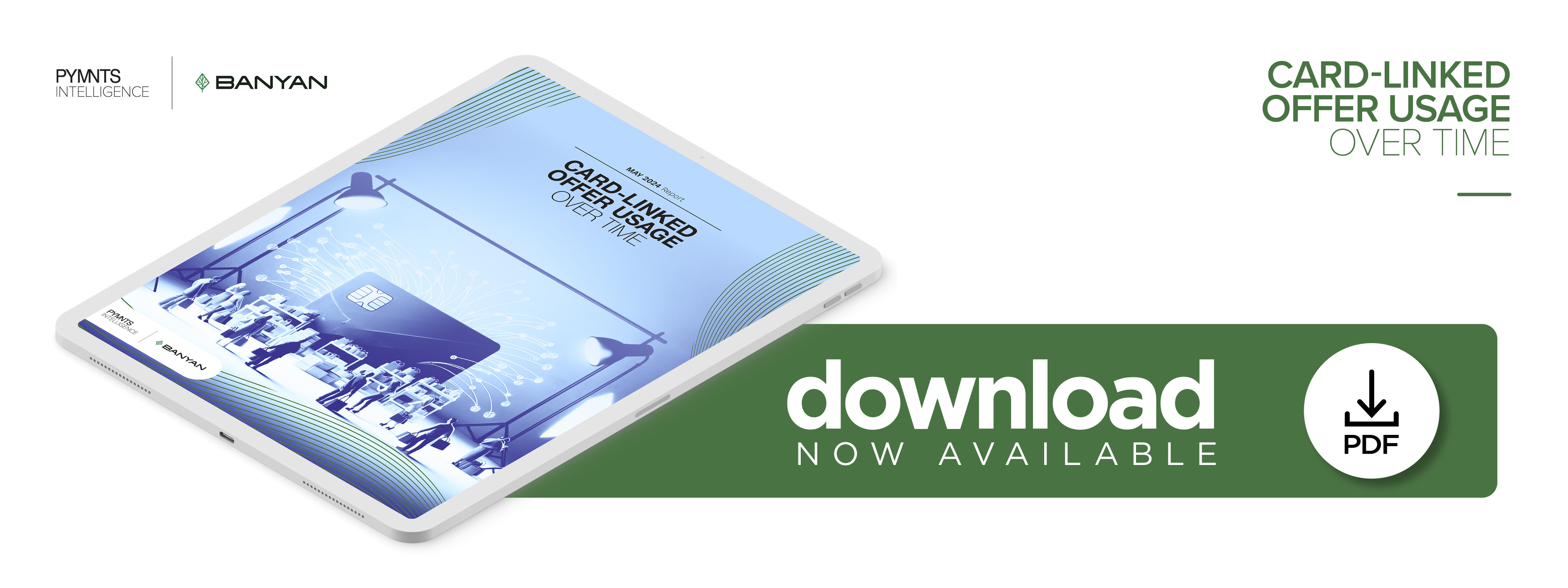
Consumers who use card-linked shopping offers, which provide special savings or rewards attached to a merchant or product, return for more — most do. But what about the 21% of past users who never return? PYMNTS Intelligence finds that if those who used these offers in the past came back, more than half of U.S. cardholders would be users. What do these consumers say keeps them from returning to card-linked offers? Irrelevant offers and unappealing deals. But the naysayers should give these offers another look. These are just some of the findings detailed in “Card-Linked Offer Usage Over Time,” a PYMNTS Intelligence and Banyan collaboration. The report examines the future growth dynamics of card-linked offers. It draws on insights from a survey of 2,108 U.S. consumers conducted from March 20 to April 6, exploring how and why they started using these offers. Other key findings in the report include the following. Former users view the lack of relevant offers as the key reason they have not yet returned. Relevancy and savings are key to drawing consumers in. Data shows that for 22% of former users, a lack of relevant offers is not just a deterrent for using cards but the key reason they do not return. These consumers’ perceptions do not match how these offers have changed. Card-linked offers are becoming more attractive in areas consumers care about — relevancy and savings — if only former users would notice. Nearly two-thirds of card-linked offer users are more satisfied with the relevancy of the offers they received this year than the previous year. Current users are noticing more improvements in their offer programs. But the same is not true for former users, who remain outside of the programs. Providers that target past users and position how the programs have improved could have a competitive advantage. More than half of past users are at least somewhat likely to use the offers again in the future. Most card-linked offer users will likely use them again. However, 63% of cardholders have not received these offers in the last year or noticed if they have. Here, providers have missed out on an opportunity. The report explores which past users are more likely to return. Providers must target consumers who have never used these offers and reengage previous users to grow usage. Download the report to learn more about how card-linked offer providers can deliver a one-two punch to unlock the next wave of growth. The post New Data: Card-Linked Offers Improve Relevance and Value appeared first on PYMNTS.com.
Increased initial public offering (IPO) activity is supporting banks, brokerage firms and law firms within the Dubai International Financial Centre’s (DIF…
Rise in IPOs Could Drive Growth for Capital Markets Across MENA Region, Says DIFC
Banking
Summary
Increased initial public offering (IPO) activity is supporting banks, brokerage firms and law firms within the Dubai International Financial Centre’s (DIFC) ecosystem, with fees for MENA deals alone exceeding $1.2billion. In a new report, ‘Regional Outlook for Banking and Capital Markets‘, produced by DIFC in partnership with LSEG Data & Analytics, the entities discuss how they expect regional IPO growth to come in three phases: The continued privatisation of state-related entities Listings by family-owned companies Fintech and tech-enabled start-ups DIFC explained that 2024 shows signs of a rebound supported by the postponement of several 2023 deals in anticipation of more favourable market conditions. In 2022, 51 IPOs took place, raising $22billion, according to EY. Privatising state-related entities could lead to greater economic diversification, private sector development and sovereign liquidity creation. By March 2024, Dubai had followed through on six of the 10 government entities it plans to take public, including Parkin, which attracted $71billion in orders. Arif Amiri, CEO of the DIFC Arif Amiri, CEO of the DIFC Authority, said: “Driven by the surge in IPOs, capital markets across the MENA region have experienced remarkable expansion, driven by reforms aimed at enhancing market infrastructure and fostering greater foreign and regional investment inflows. “With its strategic initiatives and robust regulatory framework, DIFC plays a pivotal role in driving innovation and stimulating growth within the financial sector. Dubai’s IPO boom underscores the city’s status as a thriving hub for capital markets, and DIFC’s role in enabling this acceleration through the firms that drive capital markets and provide advisory services for IPOs will continue to contribute to the dynamic evolution of global finance.” IPOs driving business growth From the private sector, listing family-owned companies is helping to drive business growth, succession planning and enhanced governance and transparency. Al Ansari Financial Services, one of the UAE’s largest remittance and foreign currency exchange companies, owned by a local family group raised $210million from its 2023 IPO. DIFC and LSEG believe now is an enticing time for other family businesses to do the same. A third wave of IPOs is expected through fintech and tech-enabled start-up exits, helping to stimulate new industries with high-growth potential, while creating strong demand from investors and viable exit options for VC investors. Proceeds from MENA equity and equity-related deals exceeded £13billion in 2023. The report also highlights how the region’s capital markets are becoming more mature, driven in Dubai by DIFC’s robust regulatory framework and commitment to innovation. DIFC is also home to more than 230 investment banks, all of which are stimulating capital markets. According to recent data, the UAE attracted a record-breaking number of High-Net-Worth Individuals (HNWIs) in 2022, which continued into 2023 and beyond. It also boasts around 109,900 resident HNWIs, including 298 centi-millionaires and 20 billionaires, prompting DIFC’s estimated 370 asset managers to strengthen their regional presence. The post Rise in IPOs Could Drive Growth for Capital Markets Across MENA Region, Says DIFC appeared first on The Fintech Times.