Fintech Radar
Discover fintech stories from around the web.
← Fintech Radar
PYMNTS · Oct. 3, 2023
Google and Microsoft Spar Over Training Rights to AI Data
Summary
Training data is the key competitive moat when it comes to generative artificial intelligence (AI). The winner-take-most dynamics of digital tech’s operational ecosystem create network effects that frequently play out across, and are captured by, huge platforms where products and services become more valuable with a larger user network. With generative AI added into the mix, those large user networks are creating positive feedback loops by way of activatable, platform-native public data that can be fed into increasingly data-hungry AI models. Microsoft CEO Satya Nadella said Monday (Oct. 2), per Reuters, while testifying during the U.S. Justice Department’s antitrust fight against Google, that Big Tech companies are competing for vast troves of content needed to train their AI models. Without naming Microsoft competitor and Google parent Alphabet, he complained other companies are locking up exclusive deals in a way that is “problematic.” While the data landscape is becoming increasingly competitive and expensive as tech firms large and small alike ramp up their efforts to build differentiated content libraries, John Schmidtlein, Google’s lead lawyer, argued that Microsoft’s data deficit is due to a series of strategic errors and an inferior search product, according to the report. Schmidtlein noted that even when Microsoft pre-installed its Bing search engine on Windows devices, it still failed to gain more than a 20% market share, with users consistently switching to Google, the report said. Adding to Microsoft’s inability to gain a foothold in the search market was the company’s failure to prepare for the mobile revolution, Schmidtlein said, as well as its failure to appropriately invest in resources like servers and engineers to build a market-leading search product. Google’s dominance in search and position as the internet’s first stop for users also provides it a competitive advantage when it comes to building out its AI models. Read also: Does Meta’s 3.59 Billion Users Give It Competitive AI Moat? Data Deficits, Distribution Rights and the Future of AI Generative AI models are typically opaque black boxes trained on publicly available web data and further refined using licensed content. An analysis by The Washington Post in April of just one data set used for training AI found that nearly the entire 30-year history of the internet has been scraped by tech companies looking to add to the billions, even trillions, of parameters their models are trained on. The Atlantic reported Aug. 19 that a dataset known as “Books3,” which included more than 191,000 books — many of them pirated — was used to train generative AI models later published by Meta, Bloomberg and others. Today’s neural networks would not have had their breakthroughs without these digital landfills that pockmark the internet. Increasingly, every activity that takes place on the internet will in some way eventually benefit an AI model by being integrated into its vast sea of training fodder. Once a piece of data has been fed into a model, it is nearly impossible to extricate that information or un-teach the AI, Fortune reported Aug. 30. See also: Peeking Under the Hood of AI’s High-Octane Technical Needs The latest generation of Meta’s AI products announced Wednesday (Sept. 27) were trained using public posts on the company’s own Facebook and Instagram platforms. Using public data on wholly-owned products is becoming a popular way for tech platforms to build out their own distinct AI content libraries, and more companies are updating their privacy policies to allow for user data to be collected to train AI models. “The algorithm is only as good as the data that it’s trained on,” Erik Duhaime, co-founder and CEO of healthcare AI startup Centaur Labs, told PYMNTS in an interview published in May. Companies including X (formerly Twitter), Microsoft, Instacart, Meta, Zoom and more are apparently of the mind that their data is best. Elon Musk-owned X’s latest privacy agreement informed users that their biometric data, job and education history, will be used to train AI and machine learning models, Bloomberg reported Aug. 30. “We may use the information we collect and publicly available information to help train our machine learning or artificial intelligence models for the purposes outlined in this policy,” the company’s updated policy stated. Musk has threatened to sue Microsoft over the “illegal” use of data from X. Meanwhile, per a Sept. 28 Reuters report, Meta said it purposefully excluded public LinkedIn data from its training set because of privacy concerns. LinkedIn is owned by Microsoft. “A lot of people are using OpenAI’s [application programming interfaces (APIs)] to test and sort of play with [generative AI] technology,” Taylor Lowe, CEO and co-founder of AI developer platform Metal, told PYMNTS in an interview published in July. “This won’t last forever … and enterprises are right to push for data privacy, up to and including running the whole stack on their own network.” For all PYMNTS AI coverage, subscribe to the daily AI Newsletter.The post Google and Microsoft Spar Over Training Rights to AI Data first appeared on PYMNTS.com.
Read on source ↗
From the fintech ecosystem

Blockchain · Digital Currencies
Unlike their U.S. counterparts, Korea’s FSC and FSS have been cautious about allowing crypto trading on traditional securities markets.
Cointelegraph · May 25, 2024
US ETH ETF approval pressures Korean regulators
Blockchain · Digital Currencies
Summary
Unlike their U.S. counterparts, Korea’s FSC and FSS have been cautious about allowing crypto trading on traditional securities markets.
Services: Ethereum, Bitcoin
Read on source ↗

Digital Currencies
Chainlink (LINK) has surged ahead of the broader cryptocurrency market, gaining 9% today and surpassing $17.50 for the first time in six weeks.
The Merkle · May 25, 2024
Chainlink Surpasses $17.50, Driven By Trading Volume and On-Chain Metrics
Digital Currencies
Summary
Chainlink (LINK) has surged ahead of the broader cryptocurrency market, gaining 9% today and surpassing $17.50 for the first time in six weeks.
Read on source ↗

Payments
This Memorial Day, many retailers are getting more targeted about how they can insert their products into shoppers’ summer celebrations.
PYMNTS · May 25, 2024
Retailers Heat Up Memorial Day With Holiday Deals and Pop-Ups
Payments
Summary
This Memorial Day, many retailers are getting more targeted about how they can insert their products into shoppers’ summer celebrations.
Read on source ↗
Blockchain · Business Tools · Digital Currencies
While Bitcoin is often marketed as "digital gold," Ethereum hasn't quite found its simple elevator pitch yet, according to crypto analysts.
Cointelegraph · May 25, 2024
Ethereum lacks a 'simple one-liner' elevator pitch for boomers — Analysts
Blockchain · Business Tools · Digital Currencies
Summary
While Bitcoin is often marketed as "digital gold," Ethereum hasn't quite found its simple elevator pitch yet, according to crypto analysts.
Services: Ethereum, James, Bitcoin
Read on source ↗

Blockchain · Digital Currencies
BlockDAG’s $32.4M Presale And Global Prominence Eclipse Ethereum And Floki Inu Developments BlockDAG (BDAG) is commanding global attention, making signifi…
The Merkle · May 25, 2024
BDAG’s Global Dominance Outshines Ethereum (ETH) Price & FLOKI News
Blockchain · Digital Currencies
Summary
BlockDAG’s $32.4M Presale And Global Prominence Eclipse Ethereum And Floki Inu Developments BlockDAG (BDAG) is commanding global attention, making significant marks from Tokyo’s Shibuya Crossing to The Sphere in Las Vegas, and notably at London’s Piccadilly Circus. With a presale that has now soared past $32.4 million, BlockDAG’s price per BDAG has risen from $0.001 to $0.009 by Batch 15, demonstrating substantial growth amidst the fluctuating prices of Ethereum and the evolving news about Floki Inu. This article delves into BlockDAG’s remarkable achievements, its strategic roadmap, and its potential to become the next major player in the cryptocurrency market. Ethereum’s Price Dynamics: Gearing for a Breakthrough Ethereum has been experiencing notable fluctuations, currently trading around $3,100 after recently regaining the $3,000 level in a bullish reversal. This resurgence has sparked interest among investors, with predictions suggesting Ethereum could breach the $5,000 threshold within the year. Despite these optimistic projections, Ethereum confronts resistance at the EMA 200-day mark, and the MACD indicator suggests an increase in selling pressure, indicating a possible short-term bearish outlook. However, maintaining above $3,000 could set Ethereum up for testing higher resistance levels and potentially trigger a breakout rally. Floki Inu’s Evolution: Beyond a Meme Coin Floki Inu, originally a meme coin linked to Elon Musk’s dog, has transitioned into a serious Web3 project, gaining traction through strategic use of social media and memes. Despite a recent 1% drop in price after exiting a bullish flag pattern, Floki Inu remains attractive to investors. Its expansion into NFTs, the Metaverse, and decentralized finance enhances its profile beyond mere meme status. Although the market shows skepticism due to its volatile price actions, the project’s potential in the Web3 arena continues to keep it relevant. BlockDAG’s Global Impact and Vision for the Future BlockDAG has effectively expanded its global footprint with strategic marketing and technology showcases. In Tokyo, the Shibuya Crossing event featured a compelling keynote video that engaged a wide audience. The Las Vegas event at The Sphere was pivotal, highlighting the release of Whitepaper V2, which expanded on BlockDAG’s blockchain advancements and the integration of the Directed Acyclic Graph (DAG) model. These global appearances have significantly enhanced BlockDAG’s visibility and contributed to the robust presale figures. In London, BlockDAG’s promotional event at Piccadilly Circus celebrated its milestones, including a CoinMarketCap listing and the continued success of its presale, which has effectively engaged a vast investor audience. The unveiling of a teaser for an upcoming keynote video set on the moon further piqued investor interest, with anticipation building for the full release. BlockDAG’s meticulously crafted 2024 roadmap outlines a clear path encompassing the launch, development, prelaunch, and final phases, each focusing on pivotal milestones such as mainnet development, securing strategic partnerships, and advancing mining operations. The successful presale, which has amassed over $32.4 million from the sale of more than 9.8 billion BDAG coins, reflects a substantial investor confidence and the viability of BlockDAG’s business model, marking a price increase from $0.001 to $0.009 per BDAG. Final Thoughts Amidst the volatility of Ethereum and the buzz around Floki Inu, BlockDAG stands out with its strategic global initiatives and an impressively successful presale. With a roadmap poised to redefine decentralized finance and a presale trajectory that promises significant returns, BlockDAG offers a compelling investment opportunity. As the crypto community eagerly awaits the full keynote reveal from the moon, BlockDAG continues to solidify its position as a leading contender in the cryptocurrency market for 2024 and beyond. Join BlockDAG Presale Now: Website: https://blockdag.network Presale: https://purchase.blockdag.network Telegram: https://t.me/blockDAGnetworkOfficial Discord: https://discord.gg/Q7BxghMVyu Disclosure: This is a sponsored press release. Please do your research before buying any cryptocurrency or investing in any projects. Read the full disclosure here. The post BDAG’s Global Dominance Outshines Ethereum (ETH) Price & FLOKI News appeared first on The Merkle News.
Services: Ethereum
Read on source ↗

Digital Currencies
FinCEN’s request for comments on how much of the Social Security number must be collected by banks is ending.
PYMNTS · May 24, 2024
Will FinCen’s Customer Identification Program Burden Banks and Consumers?
Digital Currencies
Summary
FinCEN’s request for comments on how much of the Social Security number must be collected by banks is ending.
Read on source ↗
Banking
Among consumers who expect to have to dip into their savings this year, most expect to do so to afford items and services they need, rather than to treat …
PYMNTS · May 24, 2024
Shoppers Dig Into Their Savings to Afford Essentials, Not Nice-to-Haves
Banking
Summary
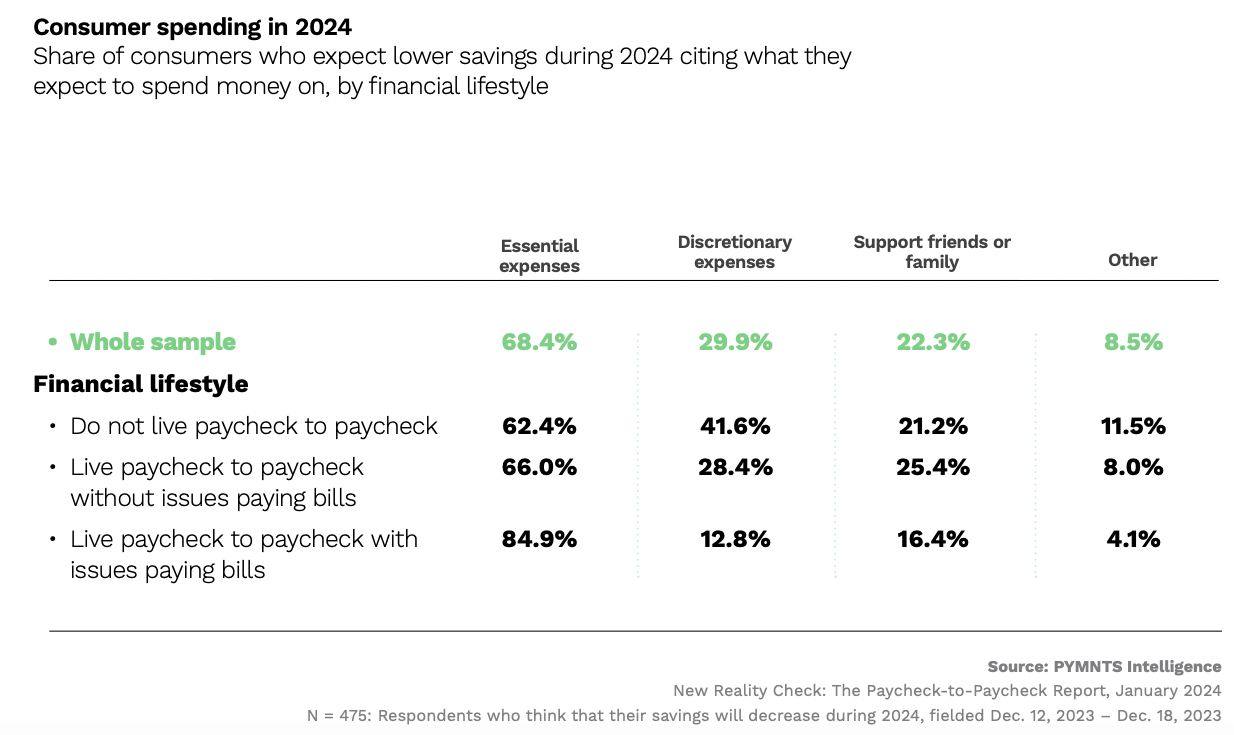
Among consumers who expect to have to dip into their savings this year, most expect to do so to afford items and services they need, rather than to treat themselves to nonessential purchases. By the Numbers “The Pessimism About Pay Rises Offsets the Effect of Falling Inflation” installment of the PYMNTS Intelligence “New Reality Check: The Paycheck-to-Paycheck Report” series drew from a survey of more than 4,000 U.S. consumers in December to examine their financial lifestyles and better understand their economic outlook. The study revealed that among the 13% of consumers who expect their savings to decrease this year, most expect to spend this money on essential expenses, with only 30% saying they would spend their savings on discretionary expenses. The Data in Context Consumers across income brackets are being thoughtful about their discretionary spending, with many cutting down on nonessential purchases in response to ongoing inflation. Retailers are noting this pullback. “Ongoing uncertainty in today’s macroeconomic and geopolitical environment, including prolonged inflation, continue to squeeze our low- to moderate-income customers’ purchasing power,” Ross Stores Executive Vice President and Chief Financial Officer Adam Orvos said during a call with analysts Thursday (May 23). Similarly, Macy’s Chairman and CEO Tony Spring noted on the company’s latest earnings call Tuesday (May 21) that the retailer’s customers continue to feel financial pressure, prompting them to “carefully scrutinize their discretionary purchases.” Even high earners are not immune. “We’re certainly seeing at the high end, the Bloomingdale’s consumer is interested in purchasing, but she’s being very thoughtful in the category she’s purchasing in,” Spring said, specifying that luxury handbag and shoe sales have been softer, but high-income shoppers are springing for advance contemporary products, beauty items and home goods. For all PYMNTS retail coverage, subscribe to the daily Retail Newsletter. The post Shoppers Dig Into Their Savings to Afford Essentials, Not Nice-to-Haves appeared first on PYMNTS.com.
Read on source ↗
Digital Currencies
With DePIN activity surging, Solana targets Firedancer upgrade to enhance network performance and accommodate growth.
Cointelegraph · May 24, 2024
Solana eyes 2025 for Firedancer rollout as DePIN activity surges
Digital Currencies
Summary
With DePIN activity surging, Solana targets Firedancer upgrade to enhance network performance and accommodate growth.
Services: Dune Analytics
Read on source ↗
Blockchain · Digital Currencies
Executive director Aya Miyaguchi said the foundation’s neutrality can’t depend on culture and individual judgment after researchers take multimillion-doll…
Cointelegraph · May 24, 2024
Ethereum Foundation to have conflict of interest policy after EigenLayer crossovers
Blockchain · Digital Currencies
Summary
Executive director Aya Miyaguchi said the foundation’s neutrality can’t depend on culture and individual judgment after researchers take multimillion-dollar roles at EigenLayer.
Services: Ethereum
Read on source ↗