Binary Options Trading on Cryptocurrencies: Exploring Challenges and Opportunities
Summary
The post Binary Options Trading on Cryptocurrencies: Exploring Challenges and Opportunities appeared first on Coinpedia Fintech News In the ever-evolving landscape of financial markets, the intersection of cryptocurrency and binary options trading has emerged as a topic of great interest. Binary options trading has gained traction due to its simplicity and potential for high returns, while cryptocurrencies like Bitcoin and Ethereum have captivated investors with their unprecedented volatility and promise of technological disruption. Combining these two worlds, binary options trading on cryptocurrencies presents a unique set of challenges and opportunities that traders need to be aware of. Understanding Binary Options Trading Before delving into the specifics of trading binary options on cryptocurrencies, let’s first understand the basics of binary options trading itself. Binary options are a type of financial derivative where the trader makes a prediction about the price movement of an underlying asset within a specified timeframe. Unlike traditional trading, where the magnitude of price movement matters, binary options traders only need to predict whether the price will be above or below a certain strike price at the expiration of the option. This simplicity is both the allure and the challenge of binary options trading. On one hand, the fixed nature of the outcome allows for straightforward risk management and the potential for substantial gains. On the other hand, the binary nature of the options means that if the prediction is incorrect, the trader could lose the entire investment. The World of Cryptocurrencies Cryptocurrencies have disrupted traditional financial systems and captured the imagination of investors worldwide. Bitcoin, often referred to as digital gold, introduced the concept of decentralized digital currency, paving the way for a multitude of other cryptocurrencies like Ethereum, Ripple, and Litecoin. One of the defining features of cryptocurrencies is their extreme price volatility. Prices can experience rapid and significant fluctuations within short timeframes, which can be both a blessing and a curse for traders. Challenges of Binary Options Trading on Cryptocurrencies Volatility as Double-Edged Sword While volatility presents an opportunity for potential gains, it also significantly amplifies the risks associated with binary options trading on cryptocurrencies. Sudden and unpredictable price swings can lead to unexpected outcomes, making accurate predictions more challenging. Traders need to carefully consider whether the volatility of the cryptocurrency market aligns with their risk tolerance and trading strategy. Regulatory Uncertainty The regulatory landscape for both cryptocurrencies and binary options varies greatly from one jurisdiction to another. Cryptocurrencies are still relatively new and are subject to evolving regulations that can impact their legality and usage. Binary options trading has also faced scrutiny in several countries due to concerns about transparency and investor protection. Traders need to navigate this complex regulatory environment and ensure they are trading on reputable and regulated platforms. Limited Market Hours Cryptocurrency markets operate 24/7, allowing traders to access the market at any time. However, binary options often have fixed expiry times, which can limit trading opportunities for those who want to capitalize on specific market events. Traders must carefully choose their options’ expiry times to align with their market analysis and strategy. Lack of Fundamental Analysis Traditional trading often involves fundamental analysis, where investors assess the underlying factors affecting an asset’s value. In the cryptocurrency market, where many assets lack traditional fundamentals like earnings reports or economic indicators, relying solely on technical analysis becomes more common. Binary options traders need to adapt their strategies to the unique characteristics of cryptocurrencies, focusing on price patterns, trends, and market sentiment. Opportunities in Binary Options Trading on Cryptocurrencies High Returns in Short Timeframes Binary options trading offers the potential for substantial returns within short timeframes. In the cryptocurrency market, where price movements can be swift and significant, traders can start binary trading on this website and have the chance to profit from these rapid fluctuations. However, it’s essential to remember that high returns come with high risks, and careful risk management is crucial. Diversification of Investment Portfolio For investors looking to diversify their portfolios, binary options on cryptocurrencies can offer an alternative asset class. Cryptocurrencies have a relatively low correlation with traditional financial markets, which means they can provide a hedge against more traditional investments like stocks and bonds. By integrating binary options trading on cryptocurrencies into their overall strategy, investors can potentially enhance their risk-adjusted returns. Leveraging Technological Tools The world of cryptocurrencies is intertwined with cutting-edge technology, including blockchain and decentralized finance (DeFi). Traders can leverage these technologies to gain insights, automate strategies, and access a wealth of market data. Algorithmic trading, for instance, can help traders execute strategies with precision and speed, taking advantage of fleeting market opportunities. Conclusion Binary options trading on cryptocurrencies merges the excitement of high-risk, high-reward trading with the unpredictability of the cryptocurrency market. Traders seeking to venture into this space must be aware of the unique challenges posed by the volatile nature of cryptocurrencies and the specific regulatory environment surrounding both binary options and digital assets. While the potential for substantial profits exists, so does the potential for significant losses. As with any trading endeavor, thorough research, risk management, and a clear understanding of one’s risk tolerance are essential. For those who can navigate the challenges and seize the opportunities, binary options trading on cryptocurrencies could provide a compelling addition to their repertoire.
The card network has teamed with Rochester Institute of Technology's Dubai satellite to foster local AI talent, and has several other AI efforts underway.
Mastercard partners with tech institute in UAE to drive AI talent
Banking · Banking Infrastructure
Summary
The card network has teamed with Rochester Institute of Technology's Dubai satellite to foster local AI talent, and has several other AI efforts underway.
Financial institutions are generally familiar with ChatGPT, but other options exist such as language models sold by Anthropic and Cohere. Research firms, …
How can a bank pick the AI model that suits it best?
Regtech · Blockchain
Summary
Financial institutions are generally familiar with ChatGPT, but other options exist such as language models sold by Anthropic and Cohere. Research firms, academics and others are racing to develop benchmarks for comparison shopping.
"While this outcome is different from what was originally planned, we’ll continue to support them and hope to work together in the future," said Ripple CE…
"While this outcome is different from what was originally planned, we’ll continue to support them and hope to work together in the future," said Ripple CEO Brad Garlinghouse.
Businesses have long relied on debit and credit card transactions, but digitization is ushering a new era of more secure electronic payment options, such …
Banks Tap Virtual Cards to Help Businesses Streamline Expense Management
Business Tools · Payments
Summary
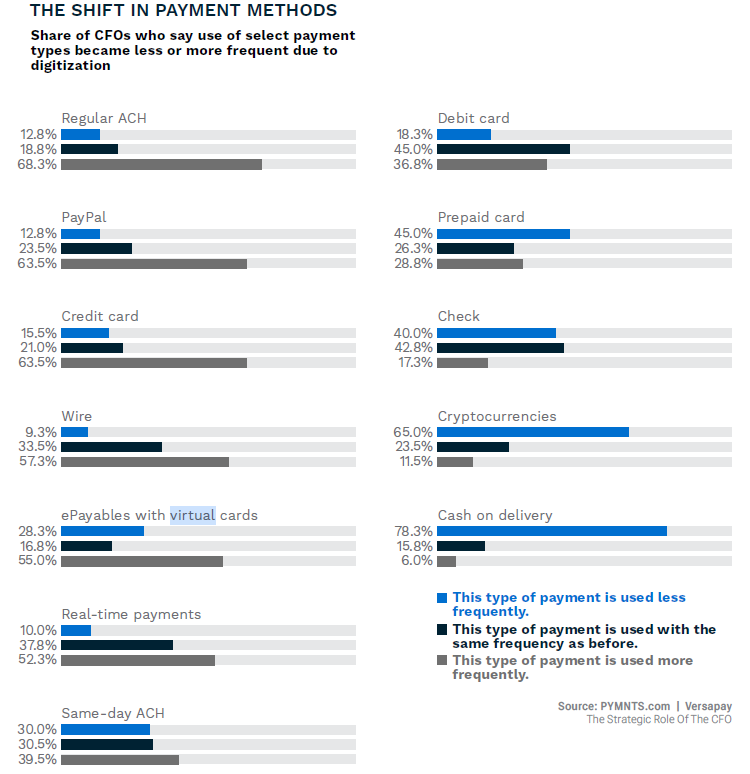
Businesses have long relied on debit and credit card transactions, but digitization is ushering a new era of more secure electronic payment options, such as virtual cards, in the business-to-business (B2B) payment landscape. Findings detailed in a PYMNTS Intelligence report titled “B2B Digital Payments: Virtual Cards Help Improve Remote Accounts Payable Efficiencies” show that the global value of virtual card transactions is expected to grow from about $2 trillion to hit $6.8 trillion by 2026, indicating a growing recognition of their simplicity and security compared to outdated methods like paper checks. When it comes to security, virtual cards provide an added layer of control for businesses as the unique and randomly generated card numbers used for each transaction significantly reduce the risk of fraud. And virtual cards are not linked to a business’s main account but to a digital wallet, minimizing exposure of sensitive data. “There’s less fraud in virtual cards. The numbers are something like 40% for ACH attempted or actual fraud, and for virtual cards, it’s around 3%,” David Bork, head of AR solutions at Boost Payment Solutions, told PYMNTS in a July interview. Additionally, “virtual cards can drive a significant amount of efficiency for an organization,” according to RJ Ancona, vice president and general manager of B2B at National Client Group, as noted in the research study. “Virtual cards [also] provide a tangible return to the organization through rewards or cash-back rebates. Companies can earn the benefits of their traditional physical cards and optimize float not offered on debit cards — all while in a 100% virtual environment,” Ancona said. In the hospitality sector, for example, virtual cards have become a popular choice for expense management and accounts payable operations, the study notes. By keeping cards on file with vendors, businesses can expedite future purchases and reduce time spent entering payment details at the point of sale. This has led to a 300% increase in virtual card use among hospitality clients since the start of the pandemic. Currently, B2B payments account for the majority of virtual card transactions, an indication that CFOs must adapt to this trend. Banks Embrace Digital-Forward Trend The recent collaboration between Visa and Lloyds Bank indicates the virtual card trend is here to stay. On Wednesday (Sept. 27), Visa announced that it is joining forces with Lloyds to launch a virtual card solution for businesses, giving employees instant virtual card access to make work-related purchases such as subscription payments or business travel. “The virtual cards — which can be single or multi-use — adopt existing approval workflows and include the business’s own unique reference fields,” Visa noted in a news release, adding that the cards “can be issued individually or by batch and offer real-time control, allowing business administrators and managers to closely manage spending within their teams.” Lloyds Bank Head of Commercial Cards James Sykes said the U.K. financial institution has “worked hard to create a solution that offers a secure, simplified process that enables businesses to pay their suppliers earlier while protecting their working capital.” The partnership comes at a time when other industry experts have noted the potential of virtual cards to transform B2B working capital management. “The movement to [virtual cards] is moving faster because it’s a matter of straight-through processing,” Alan Koenigsberg, Visa’s senior vice president and global head of large, middle market, treasury and working capital solutions, told PYMNTS CEO Karen Webster in a recent interview. “The payments are easier to reconcile, and the whole process is more holistic.” Dan Hanks, vice president of global product development at i2c, also discussed the growth in virtual card adoption, highlighting the capability of virtual card technology to replicate various traditional commercial card offerings. This customization, he said in a July interview with PYMNTS, empowers companies to tailor virtual cards for specific purposes, ensuring precise and efficient allocation of expenses. “Virtual cards are a great tool for getting all that friction out of the B2B process; vendors can process them immediately with no wait,” Hanks said, noting that “it comes down to simplification and flexibility for companies.” Boost’s Bork has a similar view, telling PYMNTS that businesses are increasingly looking to tap into the opportunities offered by commercial virtual cards as working capital becomes more important in shifting and uncertain economic times. “Having a facility for virtual card acceptance can be very powerful. It can be deployed in a widespread manner. It can be very surgically deployed. It can be deployed with different rates,” Bork said.The post Banks Tap Virtual Cards to Help Businesses Streamline Expense Management first appeared on PYMNTS.com.