Binary Options Trading on Cryptocurrencies: Exploring Challenges and Opportunities
Summary
The post Binary Options Trading on Cryptocurrencies: Exploring Challenges and Opportunities appeared first on Coinpedia Fintech News In the ever-evolving landscape of financial markets, the intersection of cryptocurrency and binary options trading has emerged as a topic of great interest. Binary options trading has gained traction due to its simplicity and potential for high returns, while cryptocurrencies like Bitcoin and Ethereum have captivated investors with their unprecedented volatility and promise of technological disruption. Combining these two worlds, binary options trading on cryptocurrencies presents a unique set of challenges and opportunities that traders need to be aware of. Understanding Binary Options Trading Before delving into the specifics of trading binary options on cryptocurrencies, let’s first understand the basics of binary options trading itself. Binary options are a type of financial derivative where the trader makes a prediction about the price movement of an underlying asset within a specified timeframe. Unlike traditional trading, where the magnitude of price movement matters, binary options traders only need to predict whether the price will be above or below a certain strike price at the expiration of the option. This simplicity is both the allure and the challenge of binary options trading. On one hand, the fixed nature of the outcome allows for straightforward risk management and the potential for substantial gains. On the other hand, the binary nature of the options means that if the prediction is incorrect, the trader could lose the entire investment. The World of Cryptocurrencies Cryptocurrencies have disrupted traditional financial systems and captured the imagination of investors worldwide. Bitcoin, often referred to as digital gold, introduced the concept of decentralized digital currency, paving the way for a multitude of other cryptocurrencies like Ethereum, Ripple, and Litecoin. One of the defining features of cryptocurrencies is their extreme price volatility. Prices can experience rapid and significant fluctuations within short timeframes, which can be both a blessing and a curse for traders. Challenges of Binary Options Trading on Cryptocurrencies Volatility as Double-Edged Sword While volatility presents an opportunity for potential gains, it also significantly amplifies the risks associated with binary options trading on cryptocurrencies. Sudden and unpredictable price swings can lead to unexpected outcomes, making accurate predictions more challenging. Traders need to carefully consider whether the volatility of the cryptocurrency market aligns with their risk tolerance and trading strategy. Regulatory Uncertainty The regulatory landscape for both cryptocurrencies and binary options varies greatly from one jurisdiction to another. Cryptocurrencies are still relatively new and are subject to evolving regulations that can impact their legality and usage. Binary options trading has also faced scrutiny in several countries due to concerns about transparency and investor protection. Traders need to navigate this complex regulatory environment and ensure they are trading on reputable and regulated platforms. Limited Market Hours Cryptocurrency markets operate 24/7, allowing traders to access the market at any time. However, binary options often have fixed expiry times, which can limit trading opportunities for those who want to capitalize on specific market events. Traders must carefully choose their options’ expiry times to align with their market analysis and strategy. Lack of Fundamental Analysis Traditional trading often involves fundamental analysis, where investors assess the underlying factors affecting an asset’s value. In the cryptocurrency market, where many assets lack traditional fundamentals like earnings reports or economic indicators, relying solely on technical analysis becomes more common. Binary options traders need to adapt their strategies to the unique characteristics of cryptocurrencies, focusing on price patterns, trends, and market sentiment. Opportunities in Binary Options Trading on Cryptocurrencies High Returns in Short Timeframes Binary options trading offers the potential for substantial returns within short timeframes. In the cryptocurrency market, where price movements can be swift and significant, traders can start binary trading on this website and have the chance to profit from these rapid fluctuations. However, it’s essential to remember that high returns come with high risks, and careful risk management is crucial. Diversification of Investment Portfolio For investors looking to diversify their portfolios, binary options on cryptocurrencies can offer an alternative asset class. Cryptocurrencies have a relatively low correlation with traditional financial markets, which means they can provide a hedge against more traditional investments like stocks and bonds. By integrating binary options trading on cryptocurrencies into their overall strategy, investors can potentially enhance their risk-adjusted returns. Leveraging Technological Tools The world of cryptocurrencies is intertwined with cutting-edge technology, including blockchain and decentralized finance (DeFi). Traders can leverage these technologies to gain insights, automate strategies, and access a wealth of market data. Algorithmic trading, for instance, can help traders execute strategies with precision and speed, taking advantage of fleeting market opportunities. Conclusion Binary options trading on cryptocurrencies merges the excitement of high-risk, high-reward trading with the unpredictability of the cryptocurrency market. Traders seeking to venture into this space must be aware of the unique challenges posed by the volatile nature of cryptocurrencies and the specific regulatory environment surrounding both binary options and digital assets. While the potential for substantial profits exists, so does the potential for significant losses. As with any trading endeavor, thorough research, risk management, and a clear understanding of one’s risk tolerance are essential. For those who can navigate the challenges and seize the opportunities, binary options trading on cryptocurrencies could provide a compelling addition to their repertoire.
In an increasingly digital world, the way we make purchases is evolving. Mobile devices have become an integral part of our lives, and with the rise of on…
In-Car Fingerprint Payments Gain Traction as Consumers Embrace Biometrics
Payments
Summary
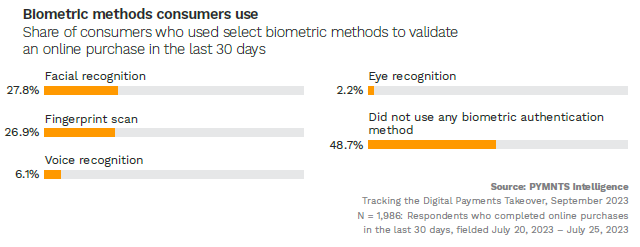
In an increasingly digital world, the way we make purchases is evolving. Mobile devices have become an integral part of our lives, and with the rise of online shopping, consumers are looking for secure and convenient ways to validate their transactions. Against this backdrop, the convenience and the security of biometric authentication have continued to gain traction, PYMNTS Intelligence finds, with a significant share of consumers opting for this technology to authenticate payments. In fact, according to a joint PYMNTS Intelligence-AWS study entitled “Tracking the Digital Payments Takeover: Biometric Authentication in the Age of Mobile,” of the nearly 60% of consumers who completed online purchases in the last 30 days, 51% used biometric authentication to validate their transactions, eliminating the need to remember passwords or enter credit card information. Drilling down into the data further reveals that facial recognition and fingerprint scans emerged as the most popular biometric methods, with about 28% and 49% of consumers using them, respectively. In addition, 58% of facial recognition users use the method more than once weekly. One interesting finding from the research is the generational divide in the adoption of biometric authentication methods. While 84% of baby boomers and seniors have not used biometric authentication methods in the past 30 days, 3 out of 4 Gen Z and millennial consumers have utilized biometrics. Among these younger generations, facial recognition is particularly popular among Gen Z consumers (51%) while millennials are more likely to prefer fingerprint scans, with 42.1% using them. Fingerprint Recognition for the Car The popularity of biometrics, and fingerprints in particular, extends beyond online shopping. On Monday (Sept. 25), Mastercard and Mercedes-Benz announced an in-car payment partnership aimed at Mercedes drivers in Germany, allowing customers to make digital payments directly from their car using their fingerprint at more than 3,600 service stations in the country. “From now on, they can pay their fuel bill directly from their car using their fingerprint — simply, securely, and conveniently,” Franz Reiner, board chairman for Mercedes-Benz Mobility AG, said in a news release. “An intuitive payment process and a best-in-class customer experience lay the foundation for the success of digital offerings.” The deal makes Mercedes-Benz the first car brand in the world to integrate Mastercard’s Card on File for Commerce Platforms technology into its vehicles, at a time when consumers are increasingly turning to biometric payment options like fingerprint scanners, PYMNTS reported. PYMNTS spoke with Mercedes CEO Nico Kersten earlier this year about his company’s development of an in-house eCommerce ecosystem, with Kersten emphasizing the importance of using fingerprint sensors to streamline the in-car payment process and increase customer convenience. “Two-factor authentication,” said Kersten, “is good for customer protection, but unfortunately it’s not so good when it comes to customer experience. So that’s why we’ve used biometrics to authenticate payments.” Prior to that in July, Swedish company Fingerprints announced that it had signed an agreement with a tier 1 automotive supplier to integrate its iris recognition technology into Driver Monitoring Systems (DMS). Without the need for any additional hardware, clients will be able to use infrared cameras to take a picture of the driver’s iris and use Fingerprints’ authentication software to detect the status of the driver. “We see an increasing interest from automotive companies in the benefits of biometrics, for example in authenticating in-car payment system transactions and enabling other advanced features, such as driver personalization and preventing the vehicle from starting unless the driver has been successfully authenticated,” the company said in a news release at the time. Also read: Fingerprints CEO Interview: Biometric Payment Cards Make a Comeback in Europe The post In-Car Fingerprint Payments Gain Traction as Consumers Embrace Biometrics first appeared on PYMNTS.com.
Banks need to — and can — take steps to manage the phenomenon, first defined by a Japanese academic in the 1970s, where artificial intelligence looks, fee…
How banks can cross the 'uncanny valley' as AI becomes more human
Banking Infrastructure · Blockchain
Summary
Banks need to — and can — take steps to manage the phenomenon, first defined by a Japanese academic in the 1970s, where artificial intelligence looks, feels or sounds human and gives customers a creepy feeling, experts say.
Each of the 11 Federal Home Loan banks will be sent a supervisory letter and an advisory bulletin on bank credit risk from their regulator the Federal Hou…
Federal Home Loan banks 'failed to meet existing expectations': OIG report
Digital Currencies
Summary
Each of the 11 Federal Home Loan banks will be sent a supervisory letter and an advisory bulletin on bank credit risk from their regulator the Federal Housing Finance Agency, according to a report from the FHFA's Office of Inspector General.
Each of the 11 Federal Home Loan Banks will be sent a supervisory letter and an advisory bulletin on bank credit risk from their regulator the Federal Hou…
Federal Home Loan Banks 'failed to meet existing expectations': OIG report
Digital Currencies
Summary
Each of the 11 Federal Home Loan Banks will be sent a supervisory letter and an advisory bulletin on bank credit risk from their regulator the Federal Housing Finance Agency, according to a report from the FHFA's Office of Inspector General.
A Piper Sandler poll found that 91% of respondents believe that either a mild or severe recession is already reflected in banks' shares. The survey also u…
Survey: Nearly three-fourths of investors say bank stocks undervalued
Digital Currencies
Summary
A Piper Sandler poll found that 91% of respondents believe that either a mild or severe recession is already reflected in banks' shares. The survey also unveiled that market participants remain concerned mostly about credit quality and aftershocks from surging interest rates.