BlockDAG’s Dev Release 35 Enhances Explorer Features, Driving Presale Beyond $30 Million
Summary
BlockDAG makes crypto buzz once again with the latest Development (Dev) Release. The 35th Dev Release focuses on enhancing off-chain computation for miners, refining mining algorithms, and advancing the UX phase of BlockDAGscan. These technical improvements are designed to boost efficiency, scalability, and security across the network. The presale success, along with the updated roadmap, further highlights BlockDAG’s momentum. The BDAG coin price has now reached $0.0085 in Batch 14, a 750% increase from the initial batch price of Batch 1. Total presale earnings have now surpassed $30 million, highlighting the growing market presence and investor appeal generated by BlockDAG’s innovative approach. BlockDAG’s Updated Roadmap: 750% Surge in Coin Value BlockDAG, a groundbreaking alternative to traditional blockchains, enables validators to add multiple blocks and process transactions in parallel, significantly enhancing scalability. This approach reduces latency, improves decentralization and employs a dynamic consensus mechanism to resolve common blockchain bottlenecks. These technological advancements have positioned BlockDAG at the forefront of the crypto industry, attracting a wide audience and increasing its market presence. Following high-profile appearances at the Piccadilly Circus in London and the original keynote display at the Shibuya Crossing in Tokyo, BlockDAG has updated its roadmap to further capitalize on this momentum. The new roadmap details the development of a comprehensive blockchain explorer, with phases covering wireframe design, UI development, and the integration of real-time data components. Key features include visualizations for node activity, smart contract transactions, and an NFT dashboard. These enhancements align with the presale success, now in Batch 14. The BlockDAG coin price has reached $0.0085, marking a 750% rise from the initial batch price and total earnings have exceeded $30 million. This progress highlights BlockDAG’s future in establishing solid innovation and market growth. BlockDAG’s Epic Dev 35 Release: Powering Future BlockDAG’s 35th Dev Release focuses on enhancing off-chain computation for miners, updating the X1 miner application and advancing the user experience phase of BlockDAGscan. The team has significantly advanced the off-chain computation capabilities crucial for the efficiency of the BlockDAG network. By refining the mining algorithms, they achieved a better balance between computational intensity and resource utilization. Notable improvements include advanced nonce generation techniques and optimized hash functions, which accelerate the mining process while reducing resource overhead. To address the varying computational capacities across the network, dynamic load balancing strategies have been implemented. These strategies use real-time monitoring and adaptive algorithms to equitably distribute tasks among miners. By leveraging predictive analytics and machine learning, the network optimizes resource utilization and prevents computational bottlenecks, enhancing overall mining efficiency. Concurrent with technical upgrades, continuous security audits ensure the integrity and resilience of the network. Through comprehensive reviews of the codebase, penetration testing, and network configuration audits, potential vulnerabilities are identified and remedied, safeguarding user data and assets. The UX phase of BlockDAGscan is underway, with significant strides made in interface design. Efforts include data sanity checks to ensure data integrity, the integration of user-friendly animations and adherence to UX best practices for a seamless and intuitive user interface. These developments collectively push towards a more efficient, scalable, and secure BlockDAG ecosystem, promising improved mining efficiency, enhanced network scalability, and robust security measures. Key Takeaways The significance of BlockDAG’s Dev Releases cannot be overstated. These regular updates are pivotal in enhancing the network’s features including efficiency, scalability and security. By continuously refining off-chain computation and advancing user experience through BlockDAGscan, these Dev Releases ensure the technology stays ahead of industry standards. This consistent innovation has directly contributed to the remarkable success of BlockDAG’s presale. With the coin price rising by 750% to $0.0085 and total earnings surpassing $30 million, it’s clear that these technical advancements are fostering investor confidence and driving market growth. BlockDAG’s commitment to development is a key factor in its burgeoning success. Join BlockDAG Presale Now: Website: https://blockdag.network Presale: https://purchase.blockdag.network Telegram: https://t.me/blockDAGnetworkOfficial Discord: https://discord.gg/Q7BxghMVyu Disclosure: This is a sponsored press release. Please do your research before buying any cryptocurrency or investing in any projects. Read the full disclosure here. The post BlockDAG’s Dev Release 35 Enhances Explorer Features, Driving Presale Beyond $30 Million appeared first on The Merkle News.
The card network has teamed with Rochester Institute of Technology's Dubai satellite to foster local AI talent, and has several other AI efforts underway.
Mastercard partners with tech institute in UAE to drive AI talent
Banking · Banking Infrastructure
Summary
The card network has teamed with Rochester Institute of Technology's Dubai satellite to foster local AI talent, and has several other AI efforts underway.
Financial institutions are generally familiar with ChatGPT, but other options exist such as language models sold by Anthropic and Cohere. Research firms, …
How can a bank pick the AI model that suits it best?
Regtech · Blockchain
Summary
Financial institutions are generally familiar with ChatGPT, but other options exist such as language models sold by Anthropic and Cohere. Research firms, academics and others are racing to develop benchmarks for comparison shopping.
"While this outcome is different from what was originally planned, we’ll continue to support them and hope to work together in the future," said Ripple CE…
"While this outcome is different from what was originally planned, we’ll continue to support them and hope to work together in the future," said Ripple CEO Brad Garlinghouse.
Businesses have long relied on debit and credit card transactions, but digitization is ushering a new era of more secure electronic payment options, such …
Banks Tap Virtual Cards to Help Businesses Streamline Expense Management
Business Tools · Payments
Summary
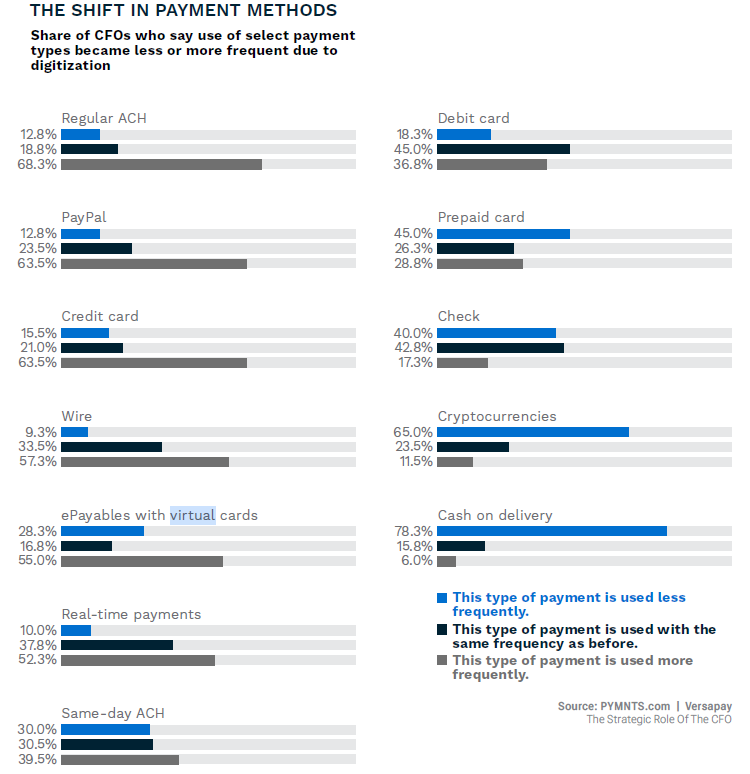
Businesses have long relied on debit and credit card transactions, but digitization is ushering a new era of more secure electronic payment options, such as virtual cards, in the business-to-business (B2B) payment landscape. Findings detailed in a PYMNTS Intelligence report titled “B2B Digital Payments: Virtual Cards Help Improve Remote Accounts Payable Efficiencies” show that the global value of virtual card transactions is expected to grow from about $2 trillion to hit $6.8 trillion by 2026, indicating a growing recognition of their simplicity and security compared to outdated methods like paper checks. When it comes to security, virtual cards provide an added layer of control for businesses as the unique and randomly generated card numbers used for each transaction significantly reduce the risk of fraud. And virtual cards are not linked to a business’s main account but to a digital wallet, minimizing exposure of sensitive data. “There’s less fraud in virtual cards. The numbers are something like 40% for ACH attempted or actual fraud, and for virtual cards, it’s around 3%,” David Bork, head of AR solutions at Boost Payment Solutions, told PYMNTS in a July interview. Additionally, “virtual cards can drive a significant amount of efficiency for an organization,” according to RJ Ancona, vice president and general manager of B2B at National Client Group, as noted in the research study. “Virtual cards [also] provide a tangible return to the organization through rewards or cash-back rebates. Companies can earn the benefits of their traditional physical cards and optimize float not offered on debit cards — all while in a 100% virtual environment,” Ancona said. In the hospitality sector, for example, virtual cards have become a popular choice for expense management and accounts payable operations, the study notes. By keeping cards on file with vendors, businesses can expedite future purchases and reduce time spent entering payment details at the point of sale. This has led to a 300% increase in virtual card use among hospitality clients since the start of the pandemic. Currently, B2B payments account for the majority of virtual card transactions, an indication that CFOs must adapt to this trend. Banks Embrace Digital-Forward Trend The recent collaboration between Visa and Lloyds Bank indicates the virtual card trend is here to stay. On Wednesday (Sept. 27), Visa announced that it is joining forces with Lloyds to launch a virtual card solution for businesses, giving employees instant virtual card access to make work-related purchases such as subscription payments or business travel. “The virtual cards — which can be single or multi-use — adopt existing approval workflows and include the business’s own unique reference fields,” Visa noted in a news release, adding that the cards “can be issued individually or by batch and offer real-time control, allowing business administrators and managers to closely manage spending within their teams.” Lloyds Bank Head of Commercial Cards James Sykes said the U.K. financial institution has “worked hard to create a solution that offers a secure, simplified process that enables businesses to pay their suppliers earlier while protecting their working capital.” The partnership comes at a time when other industry experts have noted the potential of virtual cards to transform B2B working capital management. “The movement to [virtual cards] is moving faster because it’s a matter of straight-through processing,” Alan Koenigsberg, Visa’s senior vice president and global head of large, middle market, treasury and working capital solutions, told PYMNTS CEO Karen Webster in a recent interview. “The payments are easier to reconcile, and the whole process is more holistic.” Dan Hanks, vice president of global product development at i2c, also discussed the growth in virtual card adoption, highlighting the capability of virtual card technology to replicate various traditional commercial card offerings. This customization, he said in a July interview with PYMNTS, empowers companies to tailor virtual cards for specific purposes, ensuring precise and efficient allocation of expenses. “Virtual cards are a great tool for getting all that friction out of the B2B process; vendors can process them immediately with no wait,” Hanks said, noting that “it comes down to simplification and flexibility for companies.” Boost’s Bork has a similar view, telling PYMNTS that businesses are increasingly looking to tap into the opportunities offered by commercial virtual cards as working capital becomes more important in shifting and uncertain economic times. “Having a facility for virtual card acceptance can be very powerful. It can be deployed in a widespread manner. It can be very surgically deployed. It can be deployed with different rates,” Bork said.The post Banks Tap Virtual Cards to Help Businesses Streamline Expense Management first appeared on PYMNTS.com.