Decoding Blackrock’s Bitcoin Influence: Mining Monopoly and ETF Secrets
Summary
The post Decoding Blackrock’s Bitcoin Influence: Mining Monopoly and ETF Secrets appeared first on Coinpedia Fintech News As the world was glued to the news of the Securities and Exchange Commission (SEC) delaying the approval of six Bitcoin spot ETFs, a few significant developments were quietly unfolding behind the scenes. Events that could arguably signal a potential orchestrated move by Blackrock, the world’s largest asset manager, in the Bitcoin ecosystem. Last week the Blackrock attack on Bitcoin escalated!While everyone was distracted by the recent SEC delay of the 6 Bitcoin spot ETFS, 2 BIG events just got swept under the rug!Let's examine how these 3 events together, signal a potential Blackrock attack on Bitcoin is… pic.twitter.com/K5ELfGuWBT— Satoshi (@satoshimoneybtc) September 19, 2023 Blackrock’s Mining Monopoly Blackrock has secured majority shareholding in 4 out of the 5 largest Bitcoin miners by market capitalization. The stakes are: Though Bitcoin is not a Proof of Stake (POS) cryptocurrency, making Blackrock’s influence seemingly less harmful, there’s more to this than meets the eye. Bitcoin mining is a significant determinant of its governance and future changes. Blackrock’s ownership in these major mining companies could, hypothetically, offer a lever to influence Bitcoin’s network decisions, should the asset manager opt to exert its influence. Adding fuel to the fire is the fact that the two largest Bitcoin mining pools now require their users to go through the Know Your Customer (KYC) process. KYC, previously a requisite only for regulated exchanges, now extends its tentacles into the mining realm. This compliance shift could reduce the decentralization ethos that Bitcoin has held since its inception. Why it Matters The infusion of KYC into mining pools could potentially allow companies like Blackrock to access significant amounts of data related to Bitcoin transactions. This is an alarming trend given the increasing institutionalization of Bitcoin mining. Let’s not forget that the SEC has conveniently delayed its decision on six Bitcoin spot ETFs. Among the applicants? You guessed it—Blackrock. The other companies facing delays include Invesco Galaxy, WisdomTree, Valkyrie, Bitwise, and Fidelity. The delays raise eyebrows, not because of the delay itself—which is quite typical of the SEC—but due to the simultaneous backdoor moves made by Blackrock. Is the asset manager using this as a smoke screen for its actions in the mining space? Blackrock’s Mysterious ETF Wording On Page 24 of Blackrock’s original Bitcoin ETF filing, the company states that they are under no obligation to “choose the most economic chain in the event of a Bitcoin hard fork.” Why wouldn’t Blackrock commit to selecting the most valuable Bitcoin fork? Could they be planning to create a hard fork themselves, nudging their investors onto an uneconomic chain? While we’re not making any assertions about Blackrock’s intentions, we cannot ignore the possibility that they might be subtly laying the groundwork for something more extensive!
In an increasingly digital world, the way we make purchases is evolving. Mobile devices have become an integral part of our lives, and with the rise of on…
In-Car Fingerprint Payments Gain Traction as Consumers Embrace Biometrics
Payments
Summary
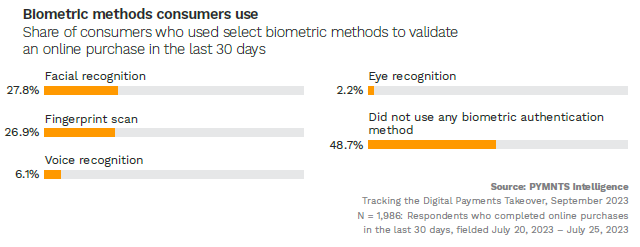
In an increasingly digital world, the way we make purchases is evolving. Mobile devices have become an integral part of our lives, and with the rise of online shopping, consumers are looking for secure and convenient ways to validate their transactions. Against this backdrop, the convenience and the security of biometric authentication have continued to gain traction, PYMNTS Intelligence finds, with a significant share of consumers opting for this technology to authenticate payments. In fact, according to a joint PYMNTS Intelligence-AWS study entitled “Tracking the Digital Payments Takeover: Biometric Authentication in the Age of Mobile,” of the nearly 60% of consumers who completed online purchases in the last 30 days, 51% used biometric authentication to validate their transactions, eliminating the need to remember passwords or enter credit card information. Drilling down into the data further reveals that facial recognition and fingerprint scans emerged as the most popular biometric methods, with about 28% and 49% of consumers using them, respectively. In addition, 58% of facial recognition users use the method more than once weekly. One interesting finding from the research is the generational divide in the adoption of biometric authentication methods. While 84% of baby boomers and seniors have not used biometric authentication methods in the past 30 days, 3 out of 4 Gen Z and millennial consumers have utilized biometrics. Among these younger generations, facial recognition is particularly popular among Gen Z consumers (51%) while millennials are more likely to prefer fingerprint scans, with 42.1% using them. Fingerprint Recognition for the Car The popularity of biometrics, and fingerprints in particular, extends beyond online shopping. On Monday (Sept. 25), Mastercard and Mercedes-Benz announced an in-car payment partnership aimed at Mercedes drivers in Germany, allowing customers to make digital payments directly from their car using their fingerprint at more than 3,600 service stations in the country. “From now on, they can pay their fuel bill directly from their car using their fingerprint — simply, securely, and conveniently,” Franz Reiner, board chairman for Mercedes-Benz Mobility AG, said in a news release. “An intuitive payment process and a best-in-class customer experience lay the foundation for the success of digital offerings.” The deal makes Mercedes-Benz the first car brand in the world to integrate Mastercard’s Card on File for Commerce Platforms technology into its vehicles, at a time when consumers are increasingly turning to biometric payment options like fingerprint scanners, PYMNTS reported. PYMNTS spoke with Mercedes CEO Nico Kersten earlier this year about his company’s development of an in-house eCommerce ecosystem, with Kersten emphasizing the importance of using fingerprint sensors to streamline the in-car payment process and increase customer convenience. “Two-factor authentication,” said Kersten, “is good for customer protection, but unfortunately it’s not so good when it comes to customer experience. So that’s why we’ve used biometrics to authenticate payments.” Prior to that in July, Swedish company Fingerprints announced that it had signed an agreement with a tier 1 automotive supplier to integrate its iris recognition technology into Driver Monitoring Systems (DMS). Without the need for any additional hardware, clients will be able to use infrared cameras to take a picture of the driver’s iris and use Fingerprints’ authentication software to detect the status of the driver. “We see an increasing interest from automotive companies in the benefits of biometrics, for example in authenticating in-car payment system transactions and enabling other advanced features, such as driver personalization and preventing the vehicle from starting unless the driver has been successfully authenticated,” the company said in a news release at the time. Also read: Fingerprints CEO Interview: Biometric Payment Cards Make a Comeback in Europe The post In-Car Fingerprint Payments Gain Traction as Consumers Embrace Biometrics first appeared on PYMNTS.com.
Banks need to — and can — take steps to manage the phenomenon, first defined by a Japanese academic in the 1970s, where artificial intelligence looks, fee…
How banks can cross the 'uncanny valley' as AI becomes more human
Banking Infrastructure · Blockchain
Summary
Banks need to — and can — take steps to manage the phenomenon, first defined by a Japanese academic in the 1970s, where artificial intelligence looks, feels or sounds human and gives customers a creepy feeling, experts say.
Each of the 11 Federal Home Loan banks will be sent a supervisory letter and an advisory bulletin on bank credit risk from their regulator the Federal Hou…
Federal Home Loan banks 'failed to meet existing expectations': OIG report
Digital Currencies
Summary
Each of the 11 Federal Home Loan banks will be sent a supervisory letter and an advisory bulletin on bank credit risk from their regulator the Federal Housing Finance Agency, according to a report from the FHFA's Office of Inspector General.
Each of the 11 Federal Home Loan Banks will be sent a supervisory letter and an advisory bulletin on bank credit risk from their regulator the Federal Hou…
Federal Home Loan Banks 'failed to meet existing expectations': OIG report
Digital Currencies
Summary
Each of the 11 Federal Home Loan Banks will be sent a supervisory letter and an advisory bulletin on bank credit risk from their regulator the Federal Housing Finance Agency, according to a report from the FHFA's Office of Inspector General.
A Piper Sandler poll found that 91% of respondents believe that either a mild or severe recession is already reflected in banks' shares. The survey also u…
Survey: Nearly three-fourths of investors say bank stocks undervalued
Digital Currencies
Summary
A Piper Sandler poll found that 91% of respondents believe that either a mild or severe recession is already reflected in banks' shares. The survey also unveiled that market participants remain concerned mostly about credit quality and aftershocks from surging interest rates.