Decoding Ethereum’s Decline: Are Foundation Sales a Red Flag?
Summary
The post Decoding Ethereum’s Decline: Are Foundation Sales a Red Flag? appeared first on Coinpedia Fintech News Ethereum, the second-largest cryptocurrency, is making headlines due to the recent actions by the Ethereum Foundation and Ethereum co-founder Vitalik Buterin. Ethereum, like many other cryptocurrencies, has been experiencing a downward trend, largely influenced by events like the Stars Arena hack, which saw nearly 3 million in crypto theft, and recent geopolitical tensions affecting the broader crypto market. According to a video by Cheeky Crypto, one of the events that has caught the crypto world’s attention is the Ethereum Foundation’s sale of millions of ETH tokens. Earlier this week, the foundation transferred a substantial amount of ETH to Uniswap, selling 1,700 ETH for $2.73 million USDC at $1,611 per coin. This sale was followed by a further 1.45% drop in the ETH price, bringing it down to $1,590. Vitalik Buterin, the co-founder of Ethereum, has also been selling off a significant amount of his ETH holdings, worth around $1.6 million on the Bitstamp exchange. This is not the first time Buterin has offloaded his ETH holdings, with approximately 4,400 ETH transferred over the past two months. Looking closer at Ethereum’s on-chain analytics, the data reveals concerning trends. Wallets across various size categories, from 100,000 to 100 ETH, have shown an aggressive selloff over the past year. Wallets holding more than 10,000 ETH have seen nearly 10% or more declines, indicating a lack of confidence in Ethereum’s future. Furthermore, Ethereum’s recent price drops have liquidated many positions. In the last 24 hours, $11.6 million worth of positions have been liquidated, with 73.3% being long and 26.6% being short positions. OKX is the exchange with the most liquidations, totaling $5.4 million. It’s unclear why the Ethereum Foundation and Vitalik Buterin are divesting their holdings, but many in the crypto community are left wondering if there’s a deeper issue affecting Ethereum’s future.
In an increasingly digital world, the way we make purchases is evolving. Mobile devices have become an integral part of our lives, and with the rise of on…
In-Car Fingerprint Payments Gain Traction as Consumers Embrace Biometrics
Payments
Summary
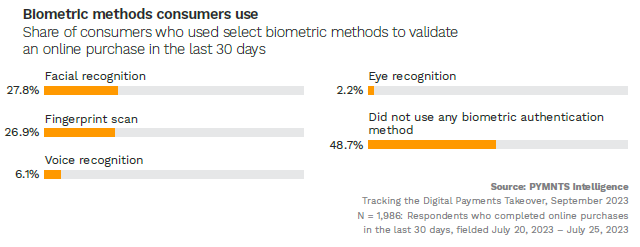
In an increasingly digital world, the way we make purchases is evolving. Mobile devices have become an integral part of our lives, and with the rise of online shopping, consumers are looking for secure and convenient ways to validate their transactions. Against this backdrop, the convenience and the security of biometric authentication have continued to gain traction, PYMNTS Intelligence finds, with a significant share of consumers opting for this technology to authenticate payments. In fact, according to a joint PYMNTS Intelligence-AWS study entitled “Tracking the Digital Payments Takeover: Biometric Authentication in the Age of Mobile,” of the nearly 60% of consumers who completed online purchases in the last 30 days, 51% used biometric authentication to validate their transactions, eliminating the need to remember passwords or enter credit card information. Drilling down into the data further reveals that facial recognition and fingerprint scans emerged as the most popular biometric methods, with about 28% and 49% of consumers using them, respectively. In addition, 58% of facial recognition users use the method more than once weekly. One interesting finding from the research is the generational divide in the adoption of biometric authentication methods. While 84% of baby boomers and seniors have not used biometric authentication methods in the past 30 days, 3 out of 4 Gen Z and millennial consumers have utilized biometrics. Among these younger generations, facial recognition is particularly popular among Gen Z consumers (51%) while millennials are more likely to prefer fingerprint scans, with 42.1% using them. Fingerprint Recognition for the Car The popularity of biometrics, and fingerprints in particular, extends beyond online shopping. On Monday (Sept. 25), Mastercard and Mercedes-Benz announced an in-car payment partnership aimed at Mercedes drivers in Germany, allowing customers to make digital payments directly from their car using their fingerprint at more than 3,600 service stations in the country. “From now on, they can pay their fuel bill directly from their car using their fingerprint — simply, securely, and conveniently,” Franz Reiner, board chairman for Mercedes-Benz Mobility AG, said in a news release. “An intuitive payment process and a best-in-class customer experience lay the foundation for the success of digital offerings.” The deal makes Mercedes-Benz the first car brand in the world to integrate Mastercard’s Card on File for Commerce Platforms technology into its vehicles, at a time when consumers are increasingly turning to biometric payment options like fingerprint scanners, PYMNTS reported. PYMNTS spoke with Mercedes CEO Nico Kersten earlier this year about his company’s development of an in-house eCommerce ecosystem, with Kersten emphasizing the importance of using fingerprint sensors to streamline the in-car payment process and increase customer convenience. “Two-factor authentication,” said Kersten, “is good for customer protection, but unfortunately it’s not so good when it comes to customer experience. So that’s why we’ve used biometrics to authenticate payments.” Prior to that in July, Swedish company Fingerprints announced that it had signed an agreement with a tier 1 automotive supplier to integrate its iris recognition technology into Driver Monitoring Systems (DMS). Without the need for any additional hardware, clients will be able to use infrared cameras to take a picture of the driver’s iris and use Fingerprints’ authentication software to detect the status of the driver. “We see an increasing interest from automotive companies in the benefits of biometrics, for example in authenticating in-car payment system transactions and enabling other advanced features, such as driver personalization and preventing the vehicle from starting unless the driver has been successfully authenticated,” the company said in a news release at the time. Also read: Fingerprints CEO Interview: Biometric Payment Cards Make a Comeback in Europe The post In-Car Fingerprint Payments Gain Traction as Consumers Embrace Biometrics first appeared on PYMNTS.com.
Banks need to — and can — take steps to manage the phenomenon, first defined by a Japanese academic in the 1970s, where artificial intelligence looks, fee…
How banks can cross the 'uncanny valley' as AI becomes more human
Banking Infrastructure · Blockchain
Summary
Banks need to — and can — take steps to manage the phenomenon, first defined by a Japanese academic in the 1970s, where artificial intelligence looks, feels or sounds human and gives customers a creepy feeling, experts say.
Each of the 11 Federal Home Loan banks will be sent a supervisory letter and an advisory bulletin on bank credit risk from their regulator the Federal Hou…
Federal Home Loan banks 'failed to meet existing expectations': OIG report
Digital Currencies
Summary
Each of the 11 Federal Home Loan banks will be sent a supervisory letter and an advisory bulletin on bank credit risk from their regulator the Federal Housing Finance Agency, according to a report from the FHFA's Office of Inspector General.
Each of the 11 Federal Home Loan Banks will be sent a supervisory letter and an advisory bulletin on bank credit risk from their regulator the Federal Hou…
Federal Home Loan Banks 'failed to meet existing expectations': OIG report
Digital Currencies
Summary
Each of the 11 Federal Home Loan Banks will be sent a supervisory letter and an advisory bulletin on bank credit risk from their regulator the Federal Housing Finance Agency, according to a report from the FHFA's Office of Inspector General.
A Piper Sandler poll found that 91% of respondents believe that either a mild or severe recession is already reflected in banks' shares. The survey also u…
Survey: Nearly three-fourths of investors say bank stocks undervalued
Digital Currencies
Summary
A Piper Sandler poll found that 91% of respondents believe that either a mild or severe recession is already reflected in banks' shares. The survey also unveiled that market participants remain concerned mostly about credit quality and aftershocks from surging interest rates.