Does Open Banking Need a New and More Effective Approach?
Summary
Since its launch in the UK, open banking has enjoyed a level of success but still lags behind the level of adoption many expected it to reach by this point in time. Advancements in the use of open banking technology appear to have plateaued in the UK and, now, a new approach is required, says James Robson, CEO of business finance platform FundOnion. Here, Robson explains what needs to change to make open banking a success once again in the UK. James Robson, CEO of FundOnion Open banking has stood out as a shining example of innovation, promising greater accessibility, transparency, and efficiency for those seeking financial services. Since its inception in 2016, financial services have moved on light years. But for open banking to truly fulfil its potential in the UK, several key areas need to be addressed: Levelling the playing field One of the fundamental principles of open banking is to foster competition and empower consumers by providing them with greater choice and access to financial services. However, the fragmented nature of the current landscape, with each bank operating its own unique APIs, presents a significant barrier to achieving this vision. To truly democratise finance, it’s key that all banks and financial services firms are able to operate on the same open banking footing. This means adopting standardised APIs and protocols, allowing for seamless integration and interoperability between different institutions. By doing so, consumers will be able to access a wider range of financial products and services from various providers, leading to increased competition, better deals, and ultimately, greater consumer empowerment. The role of the designated finance platform Since the 2008 financial crisis, the desire from major high street banks to lend to SMEs has fallen through the floor. This has made it more and more difficult for smaller firms to get access to finance, which is often key to being able to expand, invest and increase productivity. Much more so than for larger firms. The Designated Finance Platform, whereby high street banks that are unable to lend to small businesses provide referrals through a panel of brokers to other lenders, was set up to facilitate lending to these businesses and better enable growth. It is a prime example of a good idea that has not had the desired effect. Less than a quarter of businesses rejected by banks for loans are referred and even fewer will be successful. While some of this can be attributed to problems on the supply side (it is not easy for some alternative finance platforms and smaller lenders to deal with the number of leads a high street bank generates) this problem is being solved rapidly with the use of AI and open banking. This is exactly what we are working on at FundOnion, making sure that small businesses always have somewhere to go to get finance. Driving a smart data economy In an increasingly data-driven world, the ability to harness and utilise data effectively is going to be key to future growth. The UK government, along with the Open Banking Implementation Entity (OBIE), has recognised the importance of driving a smart data economy and has laid out a strategy to achieve this goal. Central to this strategy is the promotion of data interoperability and portability, allowing consumers to control and share their data securely across different platforms and services. This not only empowers individuals with greater control over their financial information but also stimulates innovation and competition within the financial sector. Furthermore, the UK can learn valuable lessons from other countries that have made significant strides in building a smart data economy. Countries like Singapore, Australia, and Canada have implemented various initiatives towards this. To keep pace with these developments, the UK must continue to invest in infrastructure, technology, and regulatory frameworks that support data-driven innovation. This includes fostering collaboration between government agencies, regulators, industry stakeholders, and academia to develop and implement policies that promote a thriving smart data economy. Regaining the lead Open banking holds tremendous promise for transforming the UK’s financial landscape, but realising this potential requires a concerted effort from all sides. By ensuring all banks and financial services firms operate on the same open banking footing, restarting and retooling useful initiatives like the Designated Finance Platform, and driving a smart data economy in alignment with global trends, the UK can reposition itself as a leader once more in the digital economy and in open banking. As we navigate the complexities of the modern financial world, it’s essential to remain committed to the principles of openness, transparency, and innovation. By embracing these principles and working together towards a common vision, we can unlock the full potential of open banking and create a brighter, more inclusive financial future for all. The post Does Open Banking Need a New and More Effective Approach? appeared first on The Fintech Times.
The post Craig Wright vs. @satoshi: Who’s Behind the Twitter Handle? appeared first on Coinpedia Fintech News A mysterious Twitter account is making waves…
Craig Wright vs. @satoshi: Who’s Behind the Twitter Handle?
Digital Currencies
Summary
The post Craig Wright vs. @satoshi: Who’s Behind the Twitter Handle? appeared first on Coinpedia Fintech News A mysterious Twitter account is making waves in the cryptocurrency world. It’s an account with the username @satoshi, and its return has everyone talking. This mysterious @satoshi Twitter account, believed to have a connection with the creator of Bitcoin, Satoshi Nakamoto, has suddenly returned after being silent since 2018. The Mysterious Identity of @satosh Broke the Silence after 5 Year. In its tweet, @satoshi said it will spend the next few months talking about important things about Bitcoin that were not in the original Bitcoin paper. The tweet also reminded everyone about how Bitcoin was created for people to use money online easily. The tweet also mentioned about the upcoming “Bitcoin halving.” This event can change how Bitcoin works and might make its price go up a lot. The tweet had some strange parts, like talking about people who might want to hide the truth and saying something about “2024 being the year of the Dragon.” Community Skepticism and Caution People are trying to figure out what these things mean. It got thousands of comments and millions of views in just a couple of hours. Meanwhile, some important folks, like an analyst named Adam Cochran and an extensive exchange called Kraken, have given their thoughts on it. They’re warning not to click on links this account might share. They’re worried that these links could be wrong and used by scammers. Who’s Hiding Behind the @satoshi Twitter Handle? People are also trying to guess who’s behind this @satoshi account. Some are jokingly calling it “faketoshi.” Others say that some words in the tweet suggest that it might not be the real Satoshi Nakamoto but maybe someone else. A theory says this account might belong to Craig Wright, who has claimed to be the real Satoshi Nakamoto. But many experts and fans of Bitcoin don’t believe him. They think it’s unlikely that this account is connected to Bitcoin’s creator. The return of the @satoshi account has created lots of excitement and mystery in the world of cryptocurrency. People are still trying to figure out what’s going on, and it’s a reminder of how fascinating and puzzling the world of digital money can be.
The generative artificial intelligence (AI) market for healthcare is valued at more than $1 billion as of 2022, and it is projected to swell to nearly $22…
Next-Level Care: Generative AI Poised for $22B Growth in Healthcare
Blockchain
Summary
The generative artificial intelligence (AI) market for healthcare is valued at more than $1 billion as of 2022, and it is projected to swell to nearly $22 billion by 2032. Technology giants, venture capitalists and private equity firms will play a significant role in that market, acting as investors, partners and innovators. Meanwhile, healthcare companies — including providers, payers, pharmaceutical companies and others — recognize generative AI’s potential to transform health and medicine and are teaming up with tech giants and startups to introduce cutting-edge AI technology to all aspects of care — from research to treatment to billing. The “Generative AI Tracker®” delves into the current state and future potential of generative AI in healthcare. It explores various use cases, examines issues and challenges, and offers examples of emerging regulations. This edition highlights select startups addressing complex healthcare challenges, including drug discovery, patient care and clinical decisions. Generative AI Companies Stand Poised to Transform the Care Continuum Healthcare-focused companies and startups are turning to generative AI innovations to tackle complex drug discovery, diagnostic testing and patient care challenges. They are securing investments, emerging from stealth mode and announcing new clients. In some instances, they are also being acquired, following a pattern commonly seen when technology becomes more established. To learn more, visit the Tracker’s Companies of Note section. Generative AI Can Improve Medical Research, Drug Development and Patient Care Large language models (LLMs), the core of generative AI, offer many applications beyond drug discovery, promising to reshape other aspects of healthcare, including provider-patient interactions and care delivery. The U.S. Department of Health and Human Services (HHS) maintains a growing list of complex and detailed AI use cases deployed or in development within the federal government. To learn more, visit the Tracker’s Innovation and Use Cases section. Generative AI’s Technology Is Not Fully Optimized for Healthcare Generative AI faces many growing pains as it seeks its footing. In a recent survey, management consulting firm Bain & Company revealed that the main barriers to generative AI in healthcare are a lack of resources, expertise and regulation, with data access and quality and organizational resistance close behind. The recurring theme across industry studies is that generative AI in healthcare is nascent and needs time to prove its efficacy and to earn public trust. To learn more, visit the Tracker’s Issues and Challenges section. About the Tracker The “Generative AI Tracker®,” a collaboration with AI-ID, delves into the current state and future potential of generative AI in healthcare. This edition examines the role that generative AI can play in transforming critical aspects of healthcare, from research to treatment.The post Next-Level Care: Generative AI Poised for $22B Growth in Healthcare first appeared on PYMNTS.com.
As biometric payments catch on across industries, restaurants looking to use these technologies to reduce friction in transactions may be best served by f…
Restaurants Considering Biometric Payments May Want to Try Fingerprint Scans
Digital Currencies
Summary
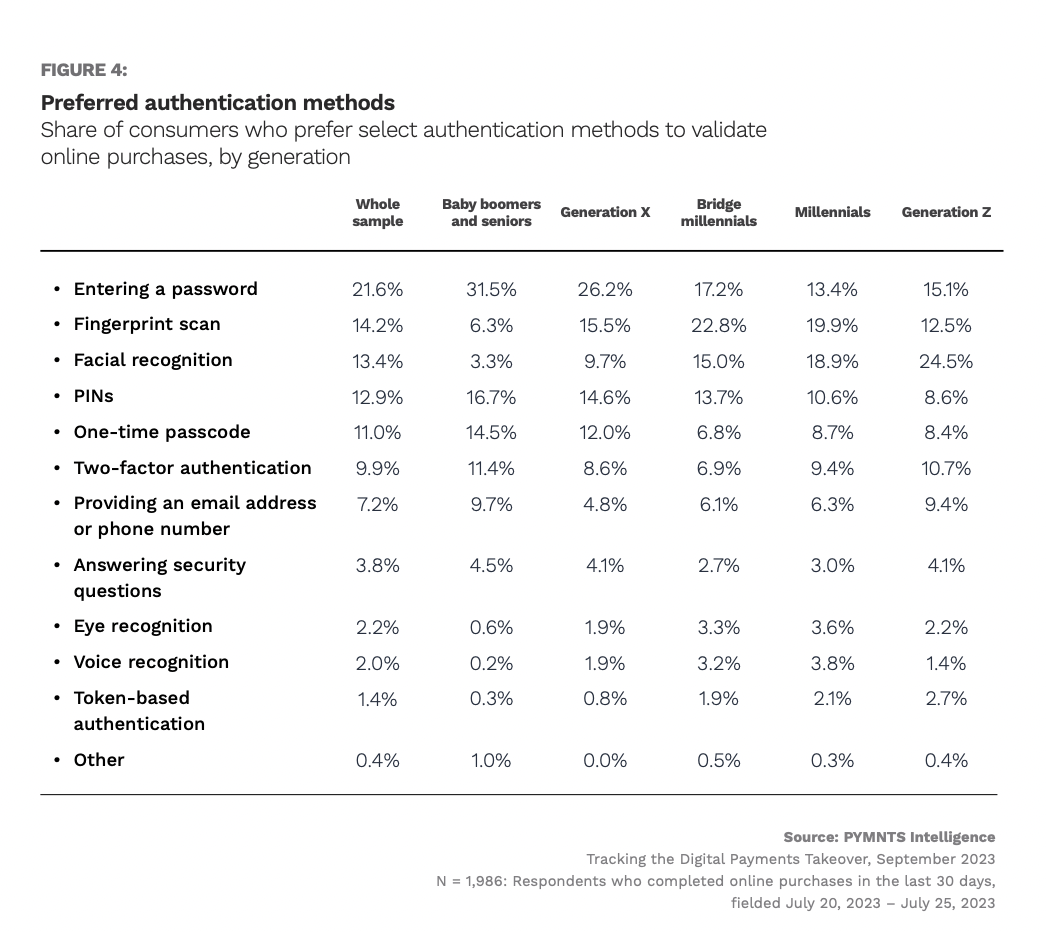
As biometric payments catch on across industries, restaurants looking to use these technologies to reduce friction in transactions may be best served by fingerprint scan technology, even if facial recognition is more common, PYMNTS Intelligence suggests. By the Numbers PYMNTS’ study “Tracking the Digital Payments Takeover: Biometric Authentication in the Age of Mobile,” created in collaboration with AWS, which draws from a census-balanced survey of more than 3,200 U.S. consumers, reveals that facial recognition is the most common kind of biometric payment for shoppers to come into contact with. Specifically, the study found that 28% consumers had used facial recognition to validate an online purchase in the last 30 days, while a slightly lower 27% said the same of fingerprint scans. Yet consumers prefer fingerprint scans to facial recognition. The study found that 14% of consumers choose the former as their preferred authentication method, while only 13% said the same of the latter. The Data in Context This preference is worthwhile for restaurants to keep in mind as more brands tap biometric payments. This summer, for instance, casual dining chain Steak ‘n Shake, which has more than 500 locations around the world, announced that it is deploying payments technology company PopID’s pay-by-face capabilities at select locations, with plans to expand it to 300 restaurants. Meanwhile, fast-casual chain Panera Bread announced this spring that it is rolling out Amazon One pay-by-palm capabilities for rewards members. “Some of the more advanced things that you see there — the things that feel futuristic, like … facial recognition — those exists today,” Olo CEO Noah Glass told PYMNTS in an interview. “What’s new is this idea that everything is tied back to a single guest profile, that [we can] bring forth, what [the customer has] ordered in the past, what they like what they dislike, and we can make recommendations based on the larger data set.”The post Restaurants Considering Biometric Payments May Want to Try Fingerprint Scans first appeared on PYMNTS.com.
As Sustainable Finance Live 2023 approaches on 10 October at Events@No6 London, Finextra spoke to a few speakers for the event to provide attendees with a…
Sustainable Finance Live sneak peek: Finastra’s Chirine Ben Zaied
Lending · Blockchain
Summary
As Sustainable Finance Live 2023 approaches on 10 October at Events@No6 London, Finextra spoke to a few speakers for the event to provide attendees with an insight into what’s to come. This week we spoke with Chirine Ben Zaied, head of innovation at Finastra who will be mentoring the hackathon to take place at the conference.
The post Ripple Ranks Among Top Innovators on 2023 Fintech 100 List appeared first on Coinpedia Fintech News Ripple, a San Francisco-based payment company…
Ripple Ranks Among Top Innovators on 2023 Fintech 100 List
Payments · Money Transfer · Digital Currencies
Summary
The post Ripple Ranks Among Top Innovators on 2023 Fintech 100 List appeared first on Coinpedia Fintech News Ripple, a San Francisco-based payment company, has proudly secured a spot on the highly esteemed 2023 Fintech 100 list. This recognition comes from Ripple’s groundbreaking efforts to modernize cross-border payments. Ripple Lab’s Remarkable Achievement: Secures Spot on Fintech 100 List Ripple Lab took to the X platform to announce their outstanding achievement, which made them earn a coveted place on the Fintech 100 list.This annual list, curated by CBInsights, indicates the top companies pioneering innovative solutions in fintech. Ripple’s recognition is a testament to its groundbreaking initiatives in the cross-border payments arena. It’s worth noting that this year’s Fintech 100 list features a diverse array of companies leading innovation in various Fintech sectors. Alongside Ripple in the cross-border payments category, notable names include Nium and TerraPay. A spokesperson from Ripple commented, “We are thrilled to be part of this prestigious list. It reflects our commitment to revolutionizing financial services and our dedication to providing efficient cross-border payment solutions.” People Magazine Applauds Ripple for Its Community-Focused Initiatives On August 29th, Ripple secured a place on People Magazine’s official list of the top 100 companies prioritizing their communities. People Magazine highlights companies that go the extra mile to value their customers, empower their employees, and positively impact the world. Ripple proudly claimed the 82nd position on this list, with People Magazine recognizing the company’s corporate social program, “Ripple Impact,” as one of the reasons for its inclusion. Ripple celebrated this achievement on the social media platform X and drew attention to its place on the San Francisco Business Times’ list of the top 100 corporate philanthropists.
Revolut has entered into an agreement with SoftBank to simplify the fintech's ownership structure to obtain a banking license in the United Kingdom, Finan…
Paving the Path to UK Banking License: Revolut Strikes Deal with SoftBank
Banking
Summary
Revolut has entered into an agreement with SoftBank to simplify the fintech's ownership structure to obtain a banking license in the United Kingdom, Financial Times reported.