Fintech Radar
Discover fintech stories from around the web.
← Fintech Radar
The Fintech Times · May 23, 2024
Does Open Banking Need a New and More Effective Approach?
Summary
Since its launch in the UK, open banking has enjoyed a level of success but still lags behind the level of adoption many expected it to reach by this point in time. Advancements in the use of open banking technology appear to have plateaued in the UK and, now, a new approach is required, says James Robson, CEO of business finance platform FundOnion. Here, Robson explains what needs to change to make open banking a success once again in the UK. James Robson, CEO of FundOnion Open banking has stood out as a shining example of innovation, promising greater accessibility, transparency, and efficiency for those seeking financial services. Since its inception in 2016, financial services have moved on light years. But for open banking to truly fulfil its potential in the UK, several key areas need to be addressed: Levelling the playing field One of the fundamental principles of open banking is to foster competition and empower consumers by providing them with greater choice and access to financial services. However, the fragmented nature of the current landscape, with each bank operating its own unique APIs, presents a significant barrier to achieving this vision. To truly democratise finance, it’s key that all banks and financial services firms are able to operate on the same open banking footing. This means adopting standardised APIs and protocols, allowing for seamless integration and interoperability between different institutions. By doing so, consumers will be able to access a wider range of financial products and services from various providers, leading to increased competition, better deals, and ultimately, greater consumer empowerment. The role of the designated finance platform Since the 2008 financial crisis, the desire from major high street banks to lend to SMEs has fallen through the floor. This has made it more and more difficult for smaller firms to get access to finance, which is often key to being able to expand, invest and increase productivity. Much more so than for larger firms. The Designated Finance Platform, whereby high street banks that are unable to lend to small businesses provide referrals through a panel of brokers to other lenders, was set up to facilitate lending to these businesses and better enable growth. It is a prime example of a good idea that has not had the desired effect. Less than a quarter of businesses rejected by banks for loans are referred and even fewer will be successful. While some of this can be attributed to problems on the supply side (it is not easy for some alternative finance platforms and smaller lenders to deal with the number of leads a high street bank generates) this problem is being solved rapidly with the use of AI and open banking. This is exactly what we are working on at FundOnion, making sure that small businesses always have somewhere to go to get finance. Driving a smart data economy In an increasingly data-driven world, the ability to harness and utilise data effectively is going to be key to future growth. The UK government, along with the Open Banking Implementation Entity (OBIE), has recognised the importance of driving a smart data economy and has laid out a strategy to achieve this goal. Central to this strategy is the promotion of data interoperability and portability, allowing consumers to control and share their data securely across different platforms and services. This not only empowers individuals with greater control over their financial information but also stimulates innovation and competition within the financial sector. Furthermore, the UK can learn valuable lessons from other countries that have made significant strides in building a smart data economy. Countries like Singapore, Australia, and Canada have implemented various initiatives towards this. To keep pace with these developments, the UK must continue to invest in infrastructure, technology, and regulatory frameworks that support data-driven innovation. This includes fostering collaboration between government agencies, regulators, industry stakeholders, and academia to develop and implement policies that promote a thriving smart data economy. Regaining the lead Open banking holds tremendous promise for transforming the UK’s financial landscape, but realising this potential requires a concerted effort from all sides. By ensuring all banks and financial services firms operate on the same open banking footing, restarting and retooling useful initiatives like the Designated Finance Platform, and driving a smart data economy in alignment with global trends, the UK can reposition itself as a leader once more in the digital economy and in open banking. As we navigate the complexities of the modern financial world, it’s essential to remain committed to the principles of openness, transparency, and innovation. By embracing these principles and working together towards a common vision, we can unlock the full potential of open banking and create a brighter, more inclusive financial future for all. The post Does Open Banking Need a New and More Effective Approach? appeared first on The Fintech Times.
Read on source ↗
From the fintech ecosystem

Blockchain
Summer is over, and school is back in session for most high schoolers across America. But two U.S. high schoolers aren’t like most others. Rohan Kalahasty…
PYMNTS · Sept. 22, 2023
These High Schoolers Are Using AI to Improve Healthcare Access
Blockchain
Summary
Summer is over, and school is back in session for most high schoolers across America. But two U.S. high schoolers aren’t like most others. Rohan Kalahasty is the co-founder, CEO and chief technology officer of medical device startup Vytal, and Sai Mattapalli is the company’s co-founder, chief operating officer and chief financial officer. Rather than worrying about early decision applications to college or the senior year football and soccer seasons, these two Virginia-based teenagers are trying to leverage artificial intelligence (AI) and connected devices to democratize access to healthcare pre-screening capabilities by identifying ocular biomarkers. “Eye tracking and brain health are connected,” Kalahasty explained. “It’s a field that’s been studied for the past 40 years, where changes in eye movements can be linked to various brain diseases including Alzheimer’s, Parkinson’s and many more.” The only problem is it takes a piece of hardware called a gaze tracking headset costing thousands of dollars to calculate those biometrics. “Although there has been a lot of research proving their usefulness, biometrics haven’t actually been utilized in a medical setting,” Kalahasty said. “It was that underutilization that inspired us [to start Vytal].” The startup’s go-to-market product provides a 30-second comprehensive and quantitative evaluation of brain health using a smartphone. “Similar to a blood pressure monitor that gives you two numbers that tell you about your health, we’re giving a set of numbers that gives the doctor information about the individual’s overall brain health,” Kalahasty said. Read also: Healthcare Industry Could Be Generative AI’s Biggest Proving Ground Democratizing Access to Healthcare Through Technology The two teens’ startup aims to overcome the limitation of expensive headsets by streamlining the process and making this biometric technology more accessible. They said they hope democratizing access to pre-screening capabilities will lead to an increase in early detection and diagnosis of brain diseases, enabling timely interventions and treatments. “The actual AI comes into play during the gaze tracking process,” Kalahasty said. “In the past, this took very expensive headsets to perform, but now, we are using an AI model that can see very accurately on the screen from just a video call which pixel the individual is looking at.” The information gathered through gaze tracking can serve as a pre-screening tool for diseases like Alzheimer’s, providing insights into a patient’s overall brain health. “All the biometrics we are measuring have already been proven to be linked to brain diseases, so the main thing that we’re worrying about is, is our gaze tracking model as accurate as the state-of-the-art headsets that those other biometrics were calculated based on,” Kalahasty added. “And from what we’re seeing, it is.” The goal is to leverage AI and modern connective capabilities to create a biomarker system that is not only highly accurate but also accessible and easy to use, helping remove friction and skepticism in healthcare diagnoses, and ultimately improving the lives of individuals. Taking a Long-Term Approach to Monitoring Cognitive Function While the information gathered through gaze tracking can serve as a prescreening tool, it can also serve equally as well as a benchmark for longitudinal brain health monitoring. Beyond simply allowing physicians to integrate brain health check-ins into annual physicals — much the same way they do with blood pressure, weight and more — biomarking tools also have the potential to serve as quantitative benchmarks for pharmaceutical breakthroughs targeting brain health and neurological treatments. “With new Alzheimer’s treatments coming out and finally being approved by the FDA, there’s a need for more quantitative ways to assess brain health and truly see if these treatments are actually regressing the illnesses they’re made to treat,” Mattapalli explained. Still, Pew Research found this year that 60% of U.S. adults reported discomfort around their healthcare provider relying on AI to diagnose diseases and recommend treatments. One in three U.S. adults said they believe it would lead to worse outcomes. “Our primary value proposition is the accessibility that we’re adding to the usage of AI,” Mattapalli said. “Because of the skepticism that currently exists with AI, the best way to convince people to actually use it is by giving them value behind it.” “People need to understand what AI is doing behind the scenes before they can trust it,” he added. “This lack of understanding is a major barrier to gaining trust. One of the best places to start is by getting doctors to trust the technology.” By making these biometrics more accessible, the two teens’ startup is paving the way for a future where healthcare is not only more efficient but also more inclusive, ensuring that everyone has access to the care they need. For all PYMNTS AI coverage, subscribe to the daily AI Newsletter.The post These High Schoolers Are Using AI to Improve Healthcare Access first appeared on PYMNTS.com.
Read on source ↗

Digital Currencies
In the run-up to FTX's bankruptcy filing, known as the Preference Period, the defendants received the benefit of withdrawals that constitute preferential …
CoinDesk · Sept. 22, 2023
FTX Sues Former Employees of Hong Kong Affiliate, Seeks $157 Million
Digital Currencies
Summary
In the run-up to FTX's bankruptcy filing, known as the Preference Period, the defendants received the benefit of withdrawals that constitute preferential transfers, the filing said.
Read on source ↗
Payments
The convenience and security biometric authentication offers continue to gain prominence. Digital-first consumers increasingly use mobile devices to shop …
PYMNTS · Sept. 22, 2023
51% of Online Buyers Used Biometrics Instead of Passwords
Payments
Summary
The convenience and security biometric authentication offers continue to gain prominence. Digital-first consumers increasingly use mobile devices to shop for everything from groceries to retail products to travel and entertainment services. Biometrics enable consumers to easily authenticate their identity when using mobile devices to pay for products and services. More than 80% of consumers using biometric authentication say they use the technologies to purchase via mobile devices. “Tracking the Digital Payments Takeover: Biometric Authentication in the Age of Mobile,” a PYMNTS Intelligence and AWS collaboration, examines consumers’ increasing reliance on biometric authentication when using mobile devices to shop online. We surveyed a census-balanced panel of 3,278 U.S. consumers between July 20 and July 25. The survey aimed to discover what consumers expect from biometrics and what drives them to use the technology. Facial recognition and fingerprint scans are the most widely used biometric methods when purchasing on mobile devices. Although spy movies and futuristic sci-fi depict eye scans and voice matching, facial recognition and fingerprint scans are the most used in the real world. Among online shoppers, 60% of fingerprint scan users use this method to validate purchases more than once a week. Fifty-eight percent of facial recognition users use the method more than once a week. Younger generations use biometrics for convenience, while older consumers use them to enhance security. Biometric authentication, especially when replacing traditional username and password authentication, has many benefits. These include increased security and fraud protection, convenience and faster checkouts. Baby boomers and seniors are most likely to cite security as a driver for using it. Generation Z consumers are significantly more inclined to value biometric authentication because it facilitates a seamless checkout experience. At least half of consumers are interested in biometrics, and merchants could persuade them to use the technology. Convincing consumers who are not interested in using biometrics to use them could prove difficult. We found that 33% of uninterested consumers would use biometrics if the merchant offered rewards or discounts for doing so. At the same time, 69% of nonusers who are interested in using biometrics say the same. Among interested nonusers, 57% are open to trying biometric authentication if the methods were available across multiple devices. Fifty percent would do so if they had more control over how often merchants require authentication. With consumers increasingly using mobile devices to shop online, biometric authentication provides a highly secure and convenient way to validate transactions. Download the report to learn how consumers use biometrics when shopping online.The post 51% of Online Buyers Used Biometrics Instead of Passwords first appeared on PYMNTS.com.
Read on source ↗
Payments
The convenience and security biometric authentication offers continue to gain prominence. Digital-first consumers increasingly use mobile devices to shop …
PYMNTS · Sept. 22, 2023
51% of Online Buyers Used Biometrics to Make a Purchase
Payments
Summary
The convenience and security biometric authentication offers continue to gain prominence. Digital-first consumers increasingly use mobile devices to shop for everything from groceries to retail products to travel and entertainment services. Biometrics enable consumers to easily authenticate their identity when using mobile devices to pay for products and services. More than 80% of consumers using biometric authentication say they use the technologies to purchase via mobile devices. “Tracking the Digital Payments Takeover: Biometric Authentication in the Age of Mobile,” a PYMNTS Intelligence and AWS collaboration, examines consumers’ increasing reliance on biometric authentication when using mobile devices to shop online. We surveyed a census-balanced panel of 3,278 U.S. consumers between July 20 and July 25. The survey aimed to discover what consumers expect from biometrics and what drives them to use the technology. Facial recognition and fingerprint scans are the most widely used biometric methods when purchasing on mobile devices. Although spy movies and futuristic sci-fi depict eye scans and voice matching, facial recognition and fingerprint scans are the most used in the real world. Among online shoppers, 60% of fingerprint scan users use this method to validate purchases more than once a week. Fifty-eight percent of facial recognition users use the method more than once a week. Younger generations use biometrics for convenience, while older consumers use them to enhance security. Biometric authentication, especially when replacing traditional username and password authentication, has many benefits. These include increased security and fraud protection, convenience and faster checkouts. Baby boomers and seniors are most likely to cite security as a driver for using it. Generation Z consumers are significantly more inclined to value biometric authentication because it facilitates a seamless checkout experience. At least half of consumers are interested in biometrics, and merchants could persuade them to use the technology. Convincing consumers who are not interested in using biometrics to use them could prove difficult. We found that 33% of uninterested consumers would use biometrics if the merchant offered rewards or discounts for doing so. At the same time, 69% of nonusers who are interested in using biometrics say the same. Among interested nonusers, 57% are open to trying biometric authentication if the methods were available across multiple devices. Fifty percent would do so if they had more control over how often merchants require authentication. With consumers increasingly using mobile devices to shop online, biometric authentication provides a highly secure and convenient way to validate transactions. Download the report to learn how consumers use biometrics when shopping online.The post 51% of Online Buyers Used Biometrics to Make a Purchase first appeared on PYMNTS.com.
Read on source ↗
Investments · Lending · Digital Currencies
Partnerships were the prime source of headlines this past week. But for the FinTech IPO Index, which gave up 5.8% through the past five sessions, the down…
PYMNTS · Sept. 22, 2023
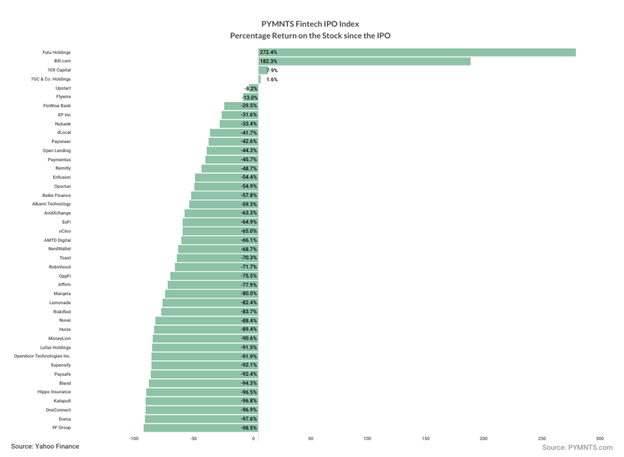
FinTech IPO Index Loses 5.8% as Platforms Plunge, Offset Spate of Partnership Announcements
Investments · Lending · Digital Currencies
Summary
Partnerships were the prime source of headlines this past week. But for the FinTech IPO Index, which gave up 5.8% through the past five sessions, the downside was led by platforms, many of which plunged double digits — not on company specific news, but on the specter that interest rates are going to be higher … for longer. The Platforms Retreat The Federal Reserve, of course, paused interest rate hikes, at least this time around, but the indications are that there will be another rate hike in the cards this year. The platforms — where higher rates pinch lending activity — have taken a hit in the meantime. Opendoor Technologies sank 25%, OneConnect lost 12.5%. Upstart stock lost 10%. In an announcement this week, Idaho Central Credit Union announced a partnership with Upstart to broaden its personal lending efforts. The announcement builds upon an existing relationship where Idaho Central Credit Union became an Upstart Referral Network lending partner in July 2022. With the Upstart Referral Network, qualified personal loan applicants on Upstart.com who meet Idaho Central’s credit policies will receive tailored offers. Robinhood gave up 6.9%. As profiled in The Wall Street Journal, and as spotlighted here, as the “Dumb Money” movie looms, Robinhood has turned itself into a “financial supermarket” that features retirement accounts and 24-hour trading. The company has been grappling with volatility in its subscriber momentum, where just last week the firm said its monthly active users for August came to 10.6 million. That’s down from 11 million at the end of July. Net cumulative funded accounts had remained flat, 22.2 million for July and August and up just 1% year over year. nCino shares were flat on the week. The company said this week that Bendigo and Adelaide Bank, an Australian FI, has selected nCino to enhance and simplify its business banking operations. As noted in the release, this decision was part of the bank’s broader strategy to reduce complexity in its operations, deliver the best experience for its customers and employees, and accelerate growth. In other partnership-related news, Payoneer and Airbnb announced enhancements to their joint efforts. As reported, Payoneer is enabling Airbnb hosts in multiple countries to get paid in local currencies. The two companies have also agreed to extend their collaboration for another three years. Payoneer’s platform and network of bank partners “not only [allow] Airbnb hosts in such locations to get paid locally but also to access and spend funds in a variety of ways, among other benefits.” Payoneer shares lost 0.5%. Nuvei announced that it has become “one of the first payments services providers to integrate” iDEAL, an enhanced solution for the leading alternative payment method in the Netherlands. The FinTech said that the integration will enable Dutch eCommerce merchants to offer a seamless payment experience as bank selection pages are directly integrated into the payment method. Nuvei shares were down 11.3% through the week. The post FinTech IPO Index Loses 5.8% as Platforms Plunge, Offset Spate of Partnership Announcements first appeared on PYMNTS.com.
Services: Robinhood, Upstart
Read on source ↗

Banking Infrastructure · Banking
Finextra sat down with Kalliopi Chioti, chief marketing at ESG officer at Temenos, and Schuyler Weiss, CEO of Alpian at the Temenos Community Forum during…
Finextra · Sept. 22, 2023
Achieving sustainable growth: Acting on ESG priorities
Banking Infrastructure · Banking
Summary
Finextra sat down with Kalliopi Chioti, chief marketing at ESG officer at Temenos, and Schuyler Weiss, CEO of Alpian at the Temenos Community Forum during May, where the experts discussed paths to sustainable growth for banks and emerging ESG solutions.
Services: Temenos, Alpian
Read on source ↗

Digital Currencies
The post ADA Price Analysis: Incoming Supply Warns A Crash in Cardano! appeared first on Coinpedia Fintech News Following a bearish pathway, the ADA price…
CoinPedia · Sept. 22, 2023
ADA Price Analysis: Incoming Supply Warns A Crash in Cardano!
Digital Currencies
Summary
The post ADA Price Analysis: Incoming Supply Warns A Crash in Cardano! appeared first on Coinpedia Fintech News Following a bearish pathway, the ADA price trades continue forming lower high formations in the 1-day chart. The downtrend brings Cardano price under the 50-day EMA line, leading to a resistance trendline formation. Currently, the ADA price shows a bullish failure to breach the overhead trendline to reclaim trend momentum. Cardano is currently trading in a sideways trend between $0.265 and $0.235 zones. Moreover, the recent bearish turn within the channel declined the ADA price by 4% within two days. This indicates a stronger bearish presence that may soon challenge the bottom support zone. Parallel to the downtrend, the possibility of a double bottom pattern forming at the support zone arises. However, the buyers must actively absorb the incoming supply to bounce back the Cardano price higher to challenge the overhead trendline. Technical indicators: Reflecting the underlying bearish sentiments, momentum indicators display ADA price on a razor-sharp edge. MACD indicator: With the MACD and signal lines ready for a bearish crossover, the indicator projects a downfall rally. RSI indicator: Despite the pullback, the RSI line maintains an uptrend and continues to display a bullish divergence. Will ADA Price Sustain Above $0.235? With bears taking over the short-term trend, the possibility of a downtrend below the consolidation range is increasing. Moreover, Bitcoin falling by more than 1% warns of a market-wide correction. In case the ADA price falls below $0.235, the market value can plunge to as low as $0.20. Conversely, a bullish reversal from $0.235 could once again test the resistance trend line, resulting in a 10% price increase to $0.25.
Services: Bitcoin, Cardano
Read on source ↗

Digital Currencies
The deal will see Bitmain receive $53.9 million worth of common CORZQ stock.
CoinDesk · Sept. 22, 2023
Bankrupt Bitcoin Miner Core Scientific to Buy 27K Bitmain Servers for $77M
Digital Currencies
Summary
The deal will see Bitmain receive $53.9 million worth of common CORZQ stock.
Services: Bitcoin
Read on source ↗
Blockchain · Banking Infrastructure · Digital Currencies
Daily transactions, daily active addresses and total value locked on Ethereum have all fallen since the upgrade, according to a report.
CoinDesk · Sept. 22, 2023
Ethereum’s Shanghai Upgrade Has Been ‘Disappointing,’ JPMorgan Says
Blockchain · Banking Infrastructure · Digital Currencies
Summary
Daily transactions, daily active addresses and total value locked on Ethereum have all fallen since the upgrade, according to a report.
Services: Ethereum, Merge
Read on source ↗