The post Ethereum’s Regulation Shift: Decrypting SEC’s Hinman Speech appeared first on Coinpedia Fintech News In the realm of digital currencies and blockchain technology, the concept of regulatory clarity has long been a subject of debate. One pivotal moment that sparked discussions about the regulatory status of Ethereum, a leading cryptocurrency, came from a significant speech by William Hinman, a prominent figure at the U.S. Securities and Exchange Commission (SEC). Hinman’s Groundbreaking Assertion "The securities laws exist so that there is no information asymmetry. Hinman said in his speech that this is no longer the case with Ethereum. And the fact that the SEC posted Hinman's speech on its website shows that the SEC views networks as decentralized as Ethereum in June… pic.twitter.com/bbPbR37NlJ— Mr. Huber (@Leerzeit) August 28, 2023 In a landmark speech hosted on the official website of the SEC, William Hinman presented a perspective that reverberated throughout the cryptocurrency community. He declared that Ethereum had outgrown its classification as a security, a statement that marked a notable departure from traditional regulatory norms. This pronouncement held particular weight due to Ethereum’s decentralized nature, challenging conventional notions of how securities laws apply. Shift in Regulatory Paradigm The SEC’s decision to publicize Hinman’s speech underscored a broader shift in regulatory attitude. It signaled the SEC’s willingness to acknowledge blockchain networks that had achieved a certain level of decentralization as entities falling outside the ambit of traditional securities regulations. Notably, by June 2018, Ethereum had crossed this threshold of decentralization, according to the SEC’s assessment. Ethereum’s Evolution and Regulatory Compliance Reflecting on Ethereum’s journey from its initial coin offering (ICO) just a year and a half prior, the platform’s growth has been nothing short of remarkable. Overcoming initial skepticism, including allegations of founder-related improprieties, Ethereum has adapted and evolved to meet the stringent investor protection standards set by the SEC. This evolution prompts a fundamental question: How should securities laws adapt to accommodate the distinct features of decentralized networks? The SEC’s evolving stance on decentralized networks, as exemplified by Ethereum, carries implications far beyond a single cryptocurrency. It serves as a potential precedent for how other blockchain platforms might be regulated in the future. This shift also invites a comprehensive reevaluation of the very notion of investor protection within the context of a decentralized landscape. Conclusion The crypto community continues to closely watch the SEC’s evolving approach to Ethereum and similar blockchain networks. William Hinman’s speech marked a turning point, ushering in a new era of regulatory contemplation. As the digital landscape evolves, the question of how to strike a balance between innovation and investor safeguards remains at the forefront, making it imperative for regulators to adapt their frameworks to the intricacies of decentralization.
The company now has 35 million users worldwide and launched new features this summer that include automated investing and expanded account access for non-…
Revolut launches app redesign, reaches 840,000 U.S. customers
Banking · Digital Currencies
Summary
The company now has 35 million users worldwide and launched new features this summer that include automated investing and expanded account access for non-citizens living in the U.S. But the features come amid controversies at the fintech.
Both NFT Ethics and blockchain analytics account Lookonchain allege that the OpenSea exec played a key role in hyping the AnubisDAO project to investors.
Nothing to see here: OpenSea denies exec involved in $60M rug pull: Nifty Newsletter
Blockchain · Lending · Digital Currencies
Summary
Both NFT Ethics and blockchain analytics account Lookonchain allege that the OpenSea exec played a key role in hyping the AnubisDAO project to investors.
Fraud and risk platform DataVisor launched its new AI Co-Pilot solution to enhance real-time fraud defense. AI Co-Pilot includes AI-automated rule tuning,…
DataVisor Launches AI Co-Pilot to Enhance Real-Time Fraud Defense
Banking
Summary
Fraud and risk platform DataVisor launched its new AI Co-Pilot solution to enhance real-time fraud defense. AI Co-Pilot includes AI-automated rule tuning, feature generation and automated debugging, and improved explainability among its features. DataVisor made its Finovate debut last month at FinovateFall in New York. Less than a month after making its Finovate debut at FinovateFall, fraud and risk platform DataVisor has launched AI Co-Pilot. The new offering is a generative AI-facilitated fraud solution designed to catch fraud 20x faster than traditional methods. AI Co-Pilot helps financial institutions detect fraud in real-time while at the same time reducing the number of false positives. This enables financial institutions to provide effective fraud defense without compromising the user experience with excessive friction. DataVisor co-founder and CEO Yinglian Xie noted that innovation in the payment space required innovation in the fraud prevention space, as well. With bank transfer and payment fraud losses in the U.S. topping $1.58 billion last year, concerns over fraud risks can serve as an impediment to many financial institutions – especially smaller FIs and credit unions – when it comes to embracing instant payments and other new services that their customers and members want. “Built on groundbreaking Generative AI technology, DataVisor’s AI Co-Pilot gives financial institutions better intelligence and automation for more effective fraud detection and prevention,” Xie said. “This innovative solution is more accurate, reacts to fraud trends much faster, and improves user experiences and customer support.” Among the new capabilities delivered by DataVisor’s AI Co-Pilot are AI-automated rule tuning to accelerate the fraud response and improve accuracy, feature generation and automated debugging, and improved explainability to ensure transparency. “(AI Co-Pilot) considerably reduces the need for analyst resources,” Xie added. “This advancement signifies a pivotal step toward enhanced security and efficiency across the industry.” Founded in 2013 and headquartered in Mountain View, California, DataVisor demoed its fraud and risk platform at FinovateFall last month. At the event, DataVisor’s Ryan Nichols and Kevin McWey showed how the technology’s rules engine, device intelligence, decision engine, and case management combine to enhance fraud detection and minimize losses. DataVisor has raised more than $94 million in funding. The company includes CMFG Ventures and NewView Capital among its investors. Last month, DataVisor introduced new Chief Revenue Officer Kevin McWey. In July, the company announced that it had partnered with cyber and fraud threat intelligence specialist Q6 Cyber. Photo by Scott Webb The post DataVisor Launches AI Co-Pilot to Enhance Real-Time Fraud Defense appeared first on Finovate.
The post FOMC Meeting Flags ‘Restrictive’ Policy And High Rates Amidst Inflation Surge! Bitcoin Price Drops Toward $26,500 appeared first on Coinpedia Fin…
FOMC Meeting Flags ‘Restrictive’ Policy And High Rates Amidst Inflation Surge! Bitcoin Price Drops Toward $26,500
Digital Currencies
Summary
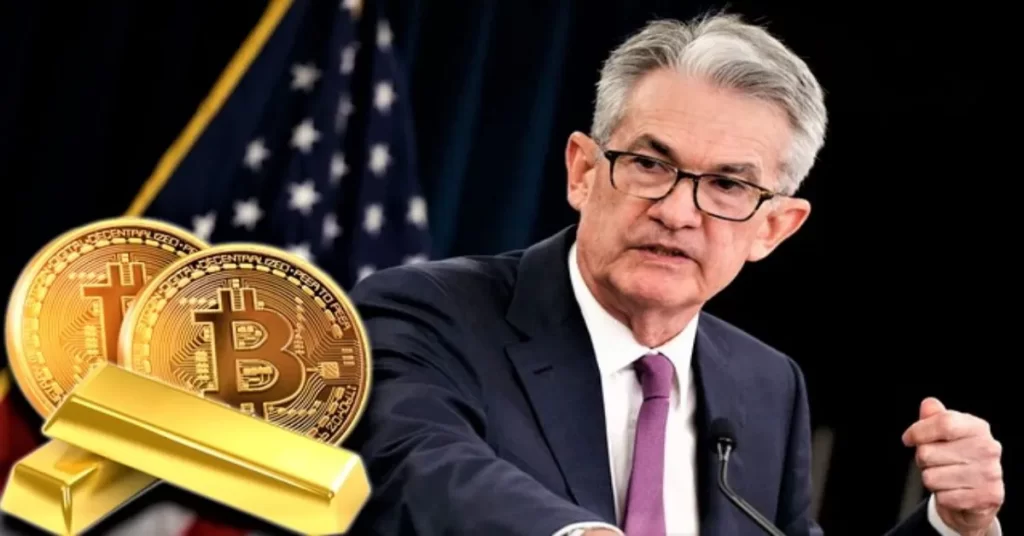
The post FOMC Meeting Flags ‘Restrictive’ Policy And High Rates Amidst Inflation Surge! Bitcoin Price Drops Toward $26,500 appeared first on Coinpedia Fintech News In a crucial moment, the Federal Open Market Committee (FOMC) has signaled a steadfast approach towards its ‘restrictive’ monetary policy amidst an ongoing inflation surge. The minutes from the recent meeting showed a commitment to maintaining higher interest rates for “some time” until inflation slows down. Following this news, Bitcoin price dropped toward the low of $26,500. FOMC Shows A ‘Restrictive’ Policy Last month, Federal Reserve policymakers reached a consensus that a sustained restrictive policy is imperative to temper ongoing inflation, while acknowledging that risks have achieved a more balanced state. “Generally, participants assessed that, given the positioning of monetary policy in a restrictive zone, risks associated with reaching the committee’s objectives have become more bifurcated,” the minutes from the September meeting, unveiled in Washington on Wednesday, stated. Despite divergent views on the necessity for additional policy tightening, there was a unanimous agreement on a singular aspect – the necessity for rates to remain high until policymakers are assured that inflation is on a trajectory back to 2%. “A majority of participants judged that one more increase in the target federal funds rate at a future meeting would likely be appropriate, while some judged it likely that no further increases would be warranted,” stated the summary of the policy meeting held from September 19-20. The document highlighted that every member of the rate-determining Federal Open Market Committee concurred that they could “navigate cautiously” regarding future decisions, which would be contingent on forthcoming data instead of any predetermined course. Unanimously, the belief was held “that policy should stay restrictive until the Committee is assured of a sustainable downward movement of inflation towards its goal.” The FOMC meeting concluded without opting for a rate hike. Bitcoin Price Made A Bearish Reaction Following the FOMC meeting, the market exhibited notable volatility. Bitcoin witnessed a substantial price drop from its crucial $27K mark, dropping toward a concerning $26,500. Surprisingly, Bitcoin has been a great investment amid economic uncertainty and the price might soon make a reversal from its current level. Nonetheless, as we near the Bitcoin halving, slated for mid-2024, the upcoming six months may be pivotal for investors, considering potential volatility. Several central bank officials, including Vice Chair Philip Jefferson, hinted at fewer rate hikes due to tightening financial conditions. FOMC minutes revealed concerns about inflation, potential economic slowdowns, and risks from tighter credit and resumed student loan payments. Despite these challenges, the economy is generally progressing toward the 2% inflation target. Earlier today, the U.S. unveiled its Producer Price Index (PPI) inflation data for September, surging by 2.2% against the anticipated 1.6%. This marks the most significant move on a year-over-year basis since April 2023. This may potentially put additional pressure on risk-on assets such as equities and cryptocurrencies. The monthly PPI rate registered at 0.5%, exceeding the projected 0.30%, compared to the prior value of 0.70%.
Bitcoin and select major altcoins are under pressure as the September Producer Price Index report shows wholesale inflation surged to 0.5%, exceeding the …
Bitcoin and select major altcoins are under pressure as the September Producer Price Index report shows wholesale inflation surged to 0.5%, exceeding the markets' expectation.