Ripple vs. SEC Lawsuit: FTCS Shields SEC’s Missteps
Summary
The post Ripple vs. SEC Lawsuit: FTCS Shields SEC’s Missteps appeared first on Coinpedia Fintech News Judge Analisa Torres had previously rejected the U.S. Securities and Exchange Commission’s (SEC) claim that Ripple’s XRP token was a security. The SEC’s aggressive legal maneuvering hurt innocent XRP holders and showcased the agency’s troubling inconsistency in regulating the crypto sector. This landmark case between the SEC and Ripple not only unveils the limitations and overreaches of the SEC but also brings into sharp focus the protections offered to federal agencies by the Federal Tort Claims Act (FTCA). "In short, the @SECGov central argument (against @Ripple) failed almost completely under judicial scrutiny. It did not just hurt defendants. The SEC harmed a lot of innocent people in the process."https://t.co/ZlV0FKn76v— CryptoLaw (@CryptoLawUS) September 28, 2023 It all began in late 2020 when the SEC filed a lawsuit against Ripple Labs, Inc., and its top executives, Brad Garlinghouse and Chris Larsen, alleging that XRP is a “security.” The case, often dubbed “the cryptocurrency case of the century,” sought billions from Ripple and its founders, setting the stage for a showdown that ultimately cost the defendants $100 million. But on July 13, 2023, Judge Torres dismantled the SEC’s central argument, ruling that most XRP sales could not be classified as securities. The SEC’s far-reaching theory, which aimed to label a digital asset as a security, resulted in immediate financial repercussions, destroying over $15 billion in wealth for XRP holders in the secondary market. Double Standards and Deception While the SEC took a public stance suggesting assets like XRP were not securities, internal documents revealed otherwise. Ripple’s defense team unearthed documents showcasing that the SEC had intentionally misled the public for years about its position on cryptocurrencies. When XRP faced severe scrutiny, ethereum got a free pass. The discovery phase of the trial was marked by an unyielding fight from the SEC to keep this evidence under wraps. The agency’s efforts to conceal the truth were so disconcerting that Magistrate Judge Sarah Netburn admonished the SEC for its “hypocrisy” and disregard for legal integrity. The SEC’s Crackdown on Crypto Exchanges But Ripple wasn’t the only one in the SEC’s crosshairs. The regulator also went after crypto giants Binance and Coinbase, leveraging the same dubious legal theory that digital assets are securities. This move suggested a broader agenda, hinting that the SEC aims to dismantle the entire crypto industry—a sentiment echoed by SEC Chairman Gary Gensler’s dismissive comments about digital currencies. Time to Amend the Federal Tort Claims Act (FTCA) While the Ripple case reveals alarming overreach and duplicitous behavior by the SEC, the current legal framework shields the agency from any consequences. The FTCA, grounded in archaic principles of sovereign immunity, essentially means that “the king can do no wrong,” leaving malicious acts by federal regulators unpunishable. In light of the Ripple case, there’s an urgent need to revisit these outdated legal provisions. The SEC’s continuous abuse of its authority further reinforces the necessity for an immediate amendment to the FTCA.
In an increasingly digital world, the way we make purchases is evolving. Mobile devices have become an integral part of our lives, and with the rise of on…
In-Car Fingerprint Payments Gain Traction as Consumers Embrace Biometrics
Payments
Summary
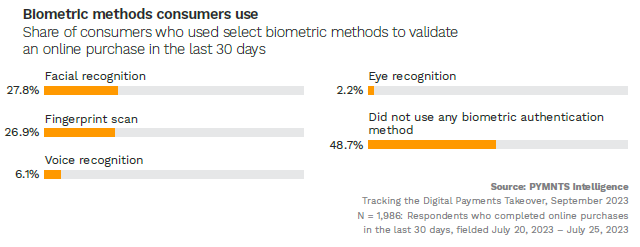
In an increasingly digital world, the way we make purchases is evolving. Mobile devices have become an integral part of our lives, and with the rise of online shopping, consumers are looking for secure and convenient ways to validate their transactions. Against this backdrop, the convenience and the security of biometric authentication have continued to gain traction, PYMNTS Intelligence finds, with a significant share of consumers opting for this technology to authenticate payments. In fact, according to a joint PYMNTS Intelligence-AWS study entitled “Tracking the Digital Payments Takeover: Biometric Authentication in the Age of Mobile,” of the nearly 60% of consumers who completed online purchases in the last 30 days, 51% used biometric authentication to validate their transactions, eliminating the need to remember passwords or enter credit card information. Drilling down into the data further reveals that facial recognition and fingerprint scans emerged as the most popular biometric methods, with about 28% and 49% of consumers using them, respectively. In addition, 58% of facial recognition users use the method more than once weekly. One interesting finding from the research is the generational divide in the adoption of biometric authentication methods. While 84% of baby boomers and seniors have not used biometric authentication methods in the past 30 days, 3 out of 4 Gen Z and millennial consumers have utilized biometrics. Among these younger generations, facial recognition is particularly popular among Gen Z consumers (51%) while millennials are more likely to prefer fingerprint scans, with 42.1% using them. Fingerprint Recognition for the Car The popularity of biometrics, and fingerprints in particular, extends beyond online shopping. On Monday (Sept. 25), Mastercard and Mercedes-Benz announced an in-car payment partnership aimed at Mercedes drivers in Germany, allowing customers to make digital payments directly from their car using their fingerprint at more than 3,600 service stations in the country. “From now on, they can pay their fuel bill directly from their car using their fingerprint — simply, securely, and conveniently,” Franz Reiner, board chairman for Mercedes-Benz Mobility AG, said in a news release. “An intuitive payment process and a best-in-class customer experience lay the foundation for the success of digital offerings.” The deal makes Mercedes-Benz the first car brand in the world to integrate Mastercard’s Card on File for Commerce Platforms technology into its vehicles, at a time when consumers are increasingly turning to biometric payment options like fingerprint scanners, PYMNTS reported. PYMNTS spoke with Mercedes CEO Nico Kersten earlier this year about his company’s development of an in-house eCommerce ecosystem, with Kersten emphasizing the importance of using fingerprint sensors to streamline the in-car payment process and increase customer convenience. “Two-factor authentication,” said Kersten, “is good for customer protection, but unfortunately it’s not so good when it comes to customer experience. So that’s why we’ve used biometrics to authenticate payments.” Prior to that in July, Swedish company Fingerprints announced that it had signed an agreement with a tier 1 automotive supplier to integrate its iris recognition technology into Driver Monitoring Systems (DMS). Without the need for any additional hardware, clients will be able to use infrared cameras to take a picture of the driver’s iris and use Fingerprints’ authentication software to detect the status of the driver. “We see an increasing interest from automotive companies in the benefits of biometrics, for example in authenticating in-car payment system transactions and enabling other advanced features, such as driver personalization and preventing the vehicle from starting unless the driver has been successfully authenticated,” the company said in a news release at the time. Also read: Fingerprints CEO Interview: Biometric Payment Cards Make a Comeback in Europe The post In-Car Fingerprint Payments Gain Traction as Consumers Embrace Biometrics first appeared on PYMNTS.com.
Banks need to — and can — take steps to manage the phenomenon, first defined by a Japanese academic in the 1970s, where artificial intelligence looks, fee…
How banks can cross the 'uncanny valley' as AI becomes more human
Banking Infrastructure · Blockchain
Summary
Banks need to — and can — take steps to manage the phenomenon, first defined by a Japanese academic in the 1970s, where artificial intelligence looks, feels or sounds human and gives customers a creepy feeling, experts say.
Each of the 11 Federal Home Loan banks will be sent a supervisory letter and an advisory bulletin on bank credit risk from their regulator the Federal Hou…
Federal Home Loan banks 'failed to meet existing expectations': OIG report
Digital Currencies
Summary
Each of the 11 Federal Home Loan banks will be sent a supervisory letter and an advisory bulletin on bank credit risk from their regulator the Federal Housing Finance Agency, according to a report from the FHFA's Office of Inspector General.
Each of the 11 Federal Home Loan Banks will be sent a supervisory letter and an advisory bulletin on bank credit risk from their regulator the Federal Hou…
Federal Home Loan Banks 'failed to meet existing expectations': OIG report
Digital Currencies
Summary
Each of the 11 Federal Home Loan Banks will be sent a supervisory letter and an advisory bulletin on bank credit risk from their regulator the Federal Housing Finance Agency, according to a report from the FHFA's Office of Inspector General.
A Piper Sandler poll found that 91% of respondents believe that either a mild or severe recession is already reflected in banks' shares. The survey also u…
Survey: Nearly three-fourths of investors say bank stocks undervalued
Digital Currencies
Summary
A Piper Sandler poll found that 91% of respondents believe that either a mild or severe recession is already reflected in banks' shares. The survey also unveiled that market participants remain concerned mostly about credit quality and aftershocks from surging interest rates.