Crypto Expert Bill Morgan Questions SEC’s Cryptocurrency Definitions
Riepilogo
The post Crypto Expert Bill Morgan Questions SEC’s Cryptocurrency Definitions appeared first on Coinpedia Fintech News Bill Morgan, a renowned attorney and crypto enthusiast, recently took to social media to express his confusion and exasperation over a statement by the Securities and Exchange Commission (SEC) in a legal brief related to a crypto case involving Coinbase. A Bewildering Statement The passage from the SEC’s document that caught Morgan’s attention raised questions about the difference between crypto assets and digital tokens. It suggested that while crypto assets might hold some inherent value, the digital token allows access to that value. Moreover, the document indicated that they wouldn’t hold any worth without the affiliated services or intellectual property these crypto assets represent. Morgan’s Interpretation Bill Morgan was dismayed at the passage, questioning its clarity and legal rationale. He was especially puzzled by the statement, which essentially seemed to convey that if digital assets hold any intrinsic worth, it’s the digital asset itself that unveils this value. Morgan found this representation to be redundant and perplexing. Can anyone interpret this passage from the SEC’s latest brief in the @coinbase matter into understandable rational legal reasoning. Seriously, what does the first sentence actually mean? What is the difference between crypto assets and digital tokens in the same sentence? /1 pic.twitter.com/zUo1eMNFyw— bill morgan (@Belisarius2020) October 7, 2023 Furthermore, Morgan scrutinized the assertion that a digital token’s only worth is linked to its associated investment contract. To him, it appeared as a roundabout way of suggesting that the value of a token solely stems from a shared venture where the worth arises from collective contributions. He also highlighted the ambiguity of the statement that tokens are devoid of value without connection to a service or intellectual rights. Morgan remarked that this notion seemed inconsistent when applied to the analysis of an investment contract. He concluded that the passage might be one of the most puzzling explanations the SEC has ever produced concerning the essence and valuation of cryptocurrency. Expert Chimes In Anders, a recognized digital asset researcher, responded to Morgan’s post, hinting at the SEC’s possible ulterior motive. He posed a question wondering if the SEC’s statement was a veiled attempt to counter Torres’ “in dicta” ruling in the Ripple case, which stated that XRP itself isn’t a security. Bill responded, suggesting that the SEC desperately tries to build a conceptual framework to convince courts that any crypto sale amounts to an investment contract. He warned that only XRP and Bitcoin would be recognized as not being securities if the SEC succeeds, leaving the rest in murky waters.
The post Craig Wright vs. @satoshi: Who’s Behind the Twitter Handle? appeared first on Coinpedia Fintech News A mysterious Twitter account is making waves…
Craig Wright vs. @satoshi: Who’s Behind the Twitter Handle?
Denaro elettronico
Riepilogo
The post Craig Wright vs. @satoshi: Who’s Behind the Twitter Handle? appeared first on Coinpedia Fintech News A mysterious Twitter account is making waves in the cryptocurrency world. It’s an account with the username @satoshi, and its return has everyone talking. This mysterious @satoshi Twitter account, believed to have a connection with the creator of Bitcoin, Satoshi Nakamoto, has suddenly returned after being silent since 2018. The Mysterious Identity of @satosh Broke the Silence after 5 Year. In its tweet, @satoshi said it will spend the next few months talking about important things about Bitcoin that were not in the original Bitcoin paper. The tweet also reminded everyone about how Bitcoin was created for people to use money online easily. The tweet also mentioned about the upcoming “Bitcoin halving.” This event can change how Bitcoin works and might make its price go up a lot. The tweet had some strange parts, like talking about people who might want to hide the truth and saying something about “2024 being the year of the Dragon.” Community Skepticism and Caution People are trying to figure out what these things mean. It got thousands of comments and millions of views in just a couple of hours. Meanwhile, some important folks, like an analyst named Adam Cochran and an extensive exchange called Kraken, have given their thoughts on it. They’re warning not to click on links this account might share. They’re worried that these links could be wrong and used by scammers. Who’s Hiding Behind the @satoshi Twitter Handle? People are also trying to guess who’s behind this @satoshi account. Some are jokingly calling it “faketoshi.” Others say that some words in the tweet suggest that it might not be the real Satoshi Nakamoto but maybe someone else. A theory says this account might belong to Craig Wright, who has claimed to be the real Satoshi Nakamoto. But many experts and fans of Bitcoin don’t believe him. They think it’s unlikely that this account is connected to Bitcoin’s creator. The return of the @satoshi account has created lots of excitement and mystery in the world of cryptocurrency. People are still trying to figure out what’s going on, and it’s a reminder of how fascinating and puzzling the world of digital money can be.
The generative artificial intelligence (AI) market for healthcare is valued at more than $1 billion as of 2022, and it is projected to swell to nearly $22…
Next-Level Care: Generative AI Poised for $22B Growth in Healthcare
Blockchain
Riepilogo
The generative artificial intelligence (AI) market for healthcare is valued at more than $1 billion as of 2022, and it is projected to swell to nearly $22 billion by 2032. Technology giants, venture capitalists and private equity firms will play a significant role in that market, acting as investors, partners and innovators. Meanwhile, healthcare companies — including providers, payers, pharmaceutical companies and others — recognize generative AI’s potential to transform health and medicine and are teaming up with tech giants and startups to introduce cutting-edge AI technology to all aspects of care — from research to treatment to billing. The “Generative AI Tracker®” delves into the current state and future potential of generative AI in healthcare. It explores various use cases, examines issues and challenges, and offers examples of emerging regulations. This edition highlights select startups addressing complex healthcare challenges, including drug discovery, patient care and clinical decisions. Generative AI Companies Stand Poised to Transform the Care Continuum Healthcare-focused companies and startups are turning to generative AI innovations to tackle complex drug discovery, diagnostic testing and patient care challenges. They are securing investments, emerging from stealth mode and announcing new clients. In some instances, they are also being acquired, following a pattern commonly seen when technology becomes more established. To learn more, visit the Tracker’s Companies of Note section. Generative AI Can Improve Medical Research, Drug Development and Patient Care Large language models (LLMs), the core of generative AI, offer many applications beyond drug discovery, promising to reshape other aspects of healthcare, including provider-patient interactions and care delivery. The U.S. Department of Health and Human Services (HHS) maintains a growing list of complex and detailed AI use cases deployed or in development within the federal government. To learn more, visit the Tracker’s Innovation and Use Cases section. Generative AI’s Technology Is Not Fully Optimized for Healthcare Generative AI faces many growing pains as it seeks its footing. In a recent survey, management consulting firm Bain & Company revealed that the main barriers to generative AI in healthcare are a lack of resources, expertise and regulation, with data access and quality and organizational resistance close behind. The recurring theme across industry studies is that generative AI in healthcare is nascent and needs time to prove its efficacy and to earn public trust. To learn more, visit the Tracker’s Issues and Challenges section. About the Tracker The “Generative AI Tracker®,” a collaboration with AI-ID, delves into the current state and future potential of generative AI in healthcare. This edition examines the role that generative AI can play in transforming critical aspects of healthcare, from research to treatment.The post Next-Level Care: Generative AI Poised for $22B Growth in Healthcare first appeared on PYMNTS.com.
As biometric payments catch on across industries, restaurants looking to use these technologies to reduce friction in transactions may be best served by f…
Restaurants Considering Biometric Payments May Want to Try Fingerprint Scans
Denaro elettronico
Riepilogo
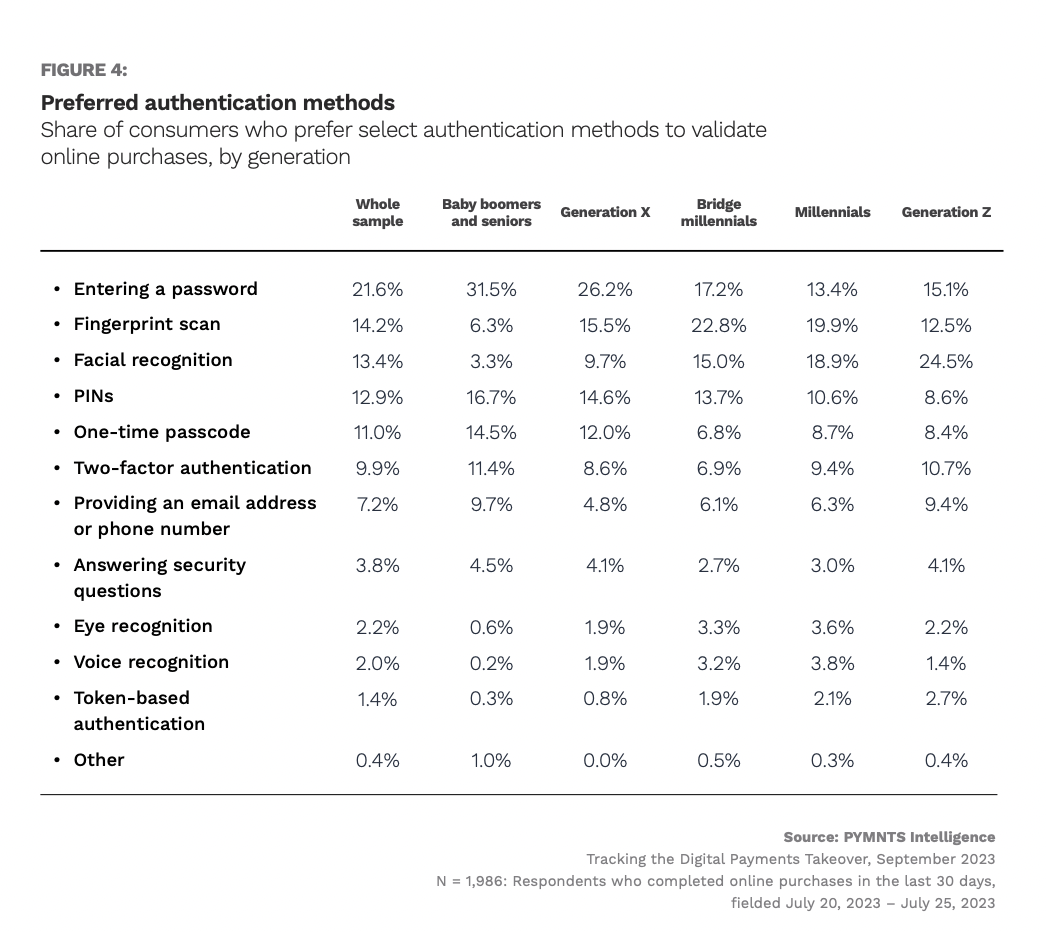
As biometric payments catch on across industries, restaurants looking to use these technologies to reduce friction in transactions may be best served by fingerprint scan technology, even if facial recognition is more common, PYMNTS Intelligence suggests. By the Numbers PYMNTS’ study “Tracking the Digital Payments Takeover: Biometric Authentication in the Age of Mobile,” created in collaboration with AWS, which draws from a census-balanced survey of more than 3,200 U.S. consumers, reveals that facial recognition is the most common kind of biometric payment for shoppers to come into contact with. Specifically, the study found that 28% consumers had used facial recognition to validate an online purchase in the last 30 days, while a slightly lower 27% said the same of fingerprint scans. Yet consumers prefer fingerprint scans to facial recognition. The study found that 14% of consumers choose the former as their preferred authentication method, while only 13% said the same of the latter. The Data in Context This preference is worthwhile for restaurants to keep in mind as more brands tap biometric payments. This summer, for instance, casual dining chain Steak ‘n Shake, which has more than 500 locations around the world, announced that it is deploying payments technology company PopID’s pay-by-face capabilities at select locations, with plans to expand it to 300 restaurants. Meanwhile, fast-casual chain Panera Bread announced this spring that it is rolling out Amazon One pay-by-palm capabilities for rewards members. “Some of the more advanced things that you see there — the things that feel futuristic, like … facial recognition — those exists today,” Olo CEO Noah Glass told PYMNTS in an interview. “What’s new is this idea that everything is tied back to a single guest profile, that [we can] bring forth, what [the customer has] ordered in the past, what they like what they dislike, and we can make recommendations based on the larger data set.”The post Restaurants Considering Biometric Payments May Want to Try Fingerprint Scans first appeared on PYMNTS.com.
As Sustainable Finance Live 2023 approaches on 10 October at Events@No6 London, Finextra spoke to a few speakers for the event to provide attendees with a…
Sustainable Finance Live sneak peek: Finastra’s Chirine Ben Zaied
Prestiti · Blockchain
Riepilogo
As Sustainable Finance Live 2023 approaches on 10 October at Events@No6 London, Finextra spoke to a few speakers for the event to provide attendees with an insight into what’s to come. This week we spoke with Chirine Ben Zaied, head of innovation at Finastra who will be mentoring the hackathon to take place at the conference.
The post Ripple Ranks Among Top Innovators on 2023 Fintech 100 List appeared first on Coinpedia Fintech News Ripple, a San Francisco-based payment company…
Ripple Ranks Among Top Innovators on 2023 Fintech 100 List
Pagamenti · Trasferimento di denaro · Denaro elettronico
Riepilogo
The post Ripple Ranks Among Top Innovators on 2023 Fintech 100 List appeared first on Coinpedia Fintech News Ripple, a San Francisco-based payment company, has proudly secured a spot on the highly esteemed 2023 Fintech 100 list. This recognition comes from Ripple’s groundbreaking efforts to modernize cross-border payments. Ripple Lab’s Remarkable Achievement: Secures Spot on Fintech 100 List Ripple Lab took to the X platform to announce their outstanding achievement, which made them earn a coveted place on the Fintech 100 list.This annual list, curated by CBInsights, indicates the top companies pioneering innovative solutions in fintech. Ripple’s recognition is a testament to its groundbreaking initiatives in the cross-border payments arena. It’s worth noting that this year’s Fintech 100 list features a diverse array of companies leading innovation in various Fintech sectors. Alongside Ripple in the cross-border payments category, notable names include Nium and TerraPay. A spokesperson from Ripple commented, “We are thrilled to be part of this prestigious list. It reflects our commitment to revolutionizing financial services and our dedication to providing efficient cross-border payment solutions.” People Magazine Applauds Ripple for Its Community-Focused Initiatives On August 29th, Ripple secured a place on People Magazine’s official list of the top 100 companies prioritizing their communities. People Magazine highlights companies that go the extra mile to value their customers, empower their employees, and positively impact the world. Ripple proudly claimed the 82nd position on this list, with People Magazine recognizing the company’s corporate social program, “Ripple Impact,” as one of the reasons for its inclusion. Ripple celebrated this achievement on the social media platform X and drew attention to its place on the San Francisco Business Times’ list of the top 100 corporate philanthropists.
Revolut has entered into an agreement with SoftBank to simplify the fintech's ownership structure to obtain a banking license in the United Kingdom, Finan…
Paving the Path to UK Banking License: Revolut Strikes Deal with SoftBank
Servizi bancari
Riepilogo
Revolut has entered into an agreement with SoftBank to simplify the fintech's ownership structure to obtain a banking license in the United Kingdom, Financial Times reported.