Ethereum’s Decentralization Under Scrutiny Amid Twitter Storm
Riepilogo
The post Ethereum’s Decentralization Under Scrutiny Amid Twitter Storm appeared first on Coinpedia Fintech News In the fast-paced world of cryptocurrencies, debates about decentralization often take center stage. A Twitter storm erupted recently when Dr. Martin Hiesboeck, Head of Research at Uphold Inc., and Steven Nerayoff, Former Ethereum Adviser, shared their thoughts on Ethereum’s decentralization. People are excited about #Ethereum – a “ decentralized blockchain” grew faster than any other tech. That isn’t true. Ethereum isn’t decentralized. It’s owned and manipulated by a handful of individuals and companies which together are a corporate entity by any other name. $ETH… pic.twitter.com/D5sa9w1YYE— Dr Martin Hiesboeck (@MHiesboeck) September 30, 2023 Dr. Hiesboeck’s tweet questioned the widely accepted notion of Ethereum being a “decentralized blockchain.” He argued that Ethereum is controlled by a select group of individuals and companies, effectively forming a corporate entity. This statement challenges the fundamental principles of decentralization that underpin cryptocurrencies. One of the points Dr. Hiesboeck raised is the impact of Layer 2 solutions and zkproofs on Ethereum’s decentralization. He suggested that Ethereum may become even more centralized as these solutions are implemented, moving away from its original vision as a truly decentralized platform. Analyzing the Ethereum Decentralization Let’s dissect Dr. Hiesboeck’s critique. Ethereum, designed by Vitalik Buterin and launched in 2015, was initially conceived as a decentralized smart contract platform, allowing developers to create decentralized applications (DApps) without intermediaries. However, concerns have arisen over time regarding its decentralization. One specific example mentioned by Dr. Hiesboeck is the ZK validator model. He argues that those not operating within centralized data centers may be disadvantaged, suggesting that Ethereum’s infrastructure may inadvertently favor centralized entities, such as venture capitalists (VCs). Steven Nerayoff’s Take Steven Nerayoff, a name synonymous with Ethereum’s early days, also raised eyebrows. Although cryptic, his tweet seemed to challenge the notion of “decentralization” as a legal construct. Nerayoff implies that this term could be manipulated to dance around securities laws—a Machiavellian stroke that could allow projects to dodge regulatory bullets. Hypothetically, if one commits securities fraud wouldn’t an “innovative” legal strategy be to get @SECGov to say it wasn’t a security? Maybe even invent a confusing legal basis like “decentralization” that nobody understands including the agency itself? Crazy talk, I know.… https://t.co/ABJVvT8tdl— Steven Nerayoff (@StevenNerayoff) September 30, 2023 Nerayoff’s tweet hints at a concern within the crypto space: the potential for regulatory compliance to conflict with the ethos of decentralization. If a project is labeled as “decentralized” by regulators, it could avoid being classified as a security, which might have significant legal implications. It’s essential to note that debates about decentralization are not new in the crypto community. Ethereum’s transition to Ethereum 2.0, a major upgrade aimed at enhancing scalability and security, reflects the ongoing efforts to maintain and even strengthen the platform’s decentralization. But the tweets by these industry veterans indicate that we might need to recalibrate our understanding of what “decentralization” truly entails. One can only wonder how Ethereum, a trailblazer in the crypto landscape, will tackle these existential queries.
The Federal Reserve vice chair for supervision said advancements in technology could put banks in a "constant struggle" to stay ahead of hackers and other…
Fed's Barr warns of looming AI 'arms race' for cybersecurity
Denaro elettronico
Riepilogo
The Federal Reserve vice chair for supervision said advancements in technology could put banks in a "constant struggle" to stay ahead of hackers and other bad actors.
Employees are more likely to view diverse and inclusive environments as healthier places to work, according to new research presented at American Banker's…
Workers have better views of employers who value diversity: Survey
Denaro elettronico
Riepilogo
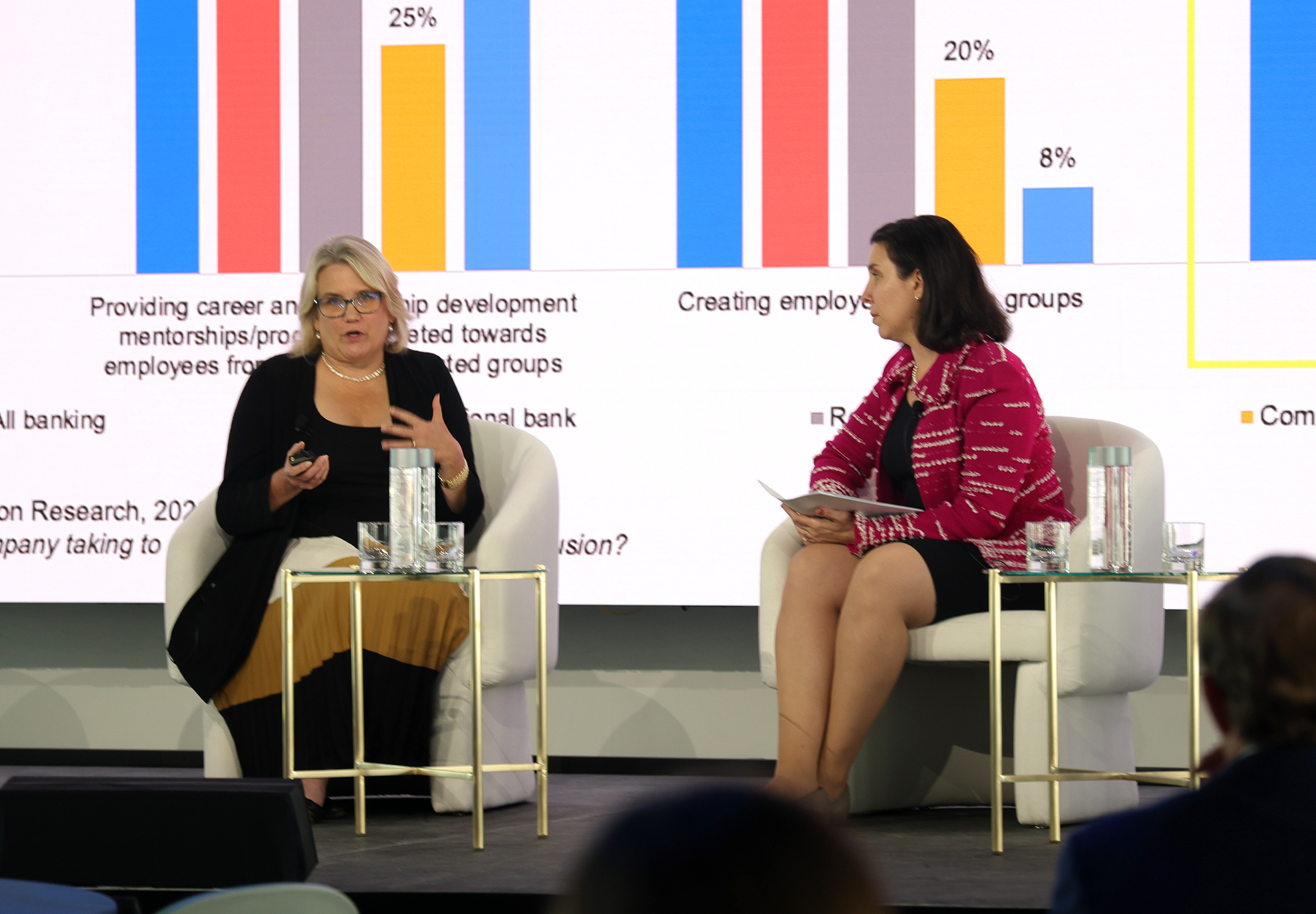
Employees are more likely to view diverse and inclusive environments as healthier places to work, according to new research presented at American Banker's Most Powerful Women in Banking conference.
Investment research firm ByteTree upgraded bitcoin’s price outlook to “bull” from “neutral” as the crypto benefits as a “safe haven” amid an equity and bo…
Bitcoin Enters ‘Quiet Bull Market’ as Safe Haven from Bond Market Turmoil, Analyst Says
Servizi per le banche · Denaro elettronico
Riepilogo
Investment research firm ByteTree upgraded bitcoin’s price outlook to “bull” from “neutral” as the crypto benefits as a “safe haven” amid an equity and bond sell-off.
In technology and other departments, women can lead with much-needed "softer" qualities, panelists at the Most Powerful Women in Banking Conference said.
Soft skills, emotional intelligence give female bankers an edge
Servizi bancari
Riepilogo
In technology and other departments, women can lead with much-needed "softer" qualities, panelists at the Most Powerful Women in Banking Conference said.