ViaBTC|Navigating LTC Halving: Conquering Obstacles for Improved Mining
Riepilogo
The post ViaBTC|Navigating LTC Halving: Conquering Obstacles for Improved Mining appeared first on Coinpedia Fintech News Litecoin just had its third halving, which marks another crypto milestone. As one of the earliest crypto projects, LTC is recognized as “the lite version of Bitcoin”. Thanks to its superior throughput, faster transactions, and lower fees. Litecoin creator Charlie Lee modelled the LTC halving, a major feature of the coin, after the underlying design of Bitcoin. Like Bitcoin, Litecoin also halves the block reward approximately every four years to ease inflation. In the early days, this mechanism was introduced to control the influx of LTC into the market. So that the coin would not be devalued by excessive inflation or suffer a liquidity crisis due to severe deflation. LTC miners will bear the brunt of the halving. In the LTC network, the mining revenue consists of the block reward and miner fee (excluding DOGE rewards), with the former accounting for over 90% of the pie. Miners have seen a 50% drop in their daily coin production following the halving. This drives up the cost, and they will face potential losses if the LTC price fails to keep up with the rising cost. Besides, the BTC mining community will have to confront the same challenge after the BTC halving next year. How should miners improve their mining experience to navigate halving? 01 Upgrade to Mining Rigs with Larger Hashrates As miners cannot control block rewards or coin prices, they focus on the hashrate arms race. In today’s miner community, one of the primary strategies is to obsolete outdated models. That fall below the shutdown price and to maximize their mining performance, thereby staying ahead even in the worst-case scenario. Models like ANTMINER L7 and WhatsMiner M50S++ come with a cost of roughly 20-40% of the revenue. They are great options to mitigate halving risks, allowing miners to continue their operations without having to shut down, even if the post-halving market uptrends do not materialize as expected. 02 Smart Mining: Auto Switch Between BTC and BCH for Maximum Revenue According to ViaWallet Explorer, the BCH halving is expected to take place on April 5, 2024, with 35,588 blocks remaining. The BTC halving, which is 38,691 blocks away, is projected for April 27, 2024. Although the exact dates may vary, the BCH halving will happen before the BTC halving. By then, miners will be able to optimize returns by switching their hashing power to the most profitable coin, provided they joined a pool like ViaBTC Pool that features [Smart Mining]. 03 Financial Tools: Capture Opportunities with Crypto Loans and Hedging Service As mining operations become more specialized, miners have to acquire more skills to thrive in the complex, volatile crypto market. Apart from know-how on mining rigs, proficiency in financial tools will also give miners an edge. Miners who can master financial tools often maximize the returns on existing funds and achieve greater capital efficiency compared to those solely focusing on mining. ViaBTC offers two financial tools, [Hedging Service] and [Crypto Loans]. Based on traditional financial principles, they help miners maximize returns using limited funds under different market conditions. *Find out more about Crypto Loans and Hedging Service at: https://www.viabtc.com/finance/loan-tutorial https://www.viabtc.com/finance/hedging-tutorial In a market downturn, miners proficient in financial tools can borrow coins through [Hedging Service] and sell them at current market prices to secure profits in advance. Similarly, during bullish periods, they collateralize assets for more liquidity via [Crypto Loans], instead of dumping the cryptos they mined. Conclusion So far this year, the BTC hashrate has grown by nearly 50%, and the LTC hashrate has gone up by almost 40%. As traditional giants like BlackRock, Deutsche Bank, and Fidelity Investments embrace crypto, the mining industry has been presented with new growth opportunities. The rising hashrates, fast iterations of mining rigs by upstream manufacturers, and global regulatory uncertainties present mounting challenges for miners focusing on small-scale operations. To survive in this dog-eat-dog world, small-scale miners must always stand ready to improve mining strategies and adjust fund allocation.
Nexi, a European payment technology company, has announced that merchants in Italy can now accept in-person contactless payments using Tap to Pay on iPhon…
Nexi Takes the Wraps Off Tap to Pay on iPhone for Italian Merchants
Pagamenti
Riepilogo
Nexi, a European payment technology company, has announced that merchants in Italy can now accept in-person contactless payments using Tap to Pay on iPhone.
Fuse, launched in January 2023, aims to facilitate cross-border payments for global businesses, particularly focusing on the GCC (Gulf Cooperation Council…
Fuse Technology Simplifies Cross-Border Payments for Global Businesses in the GCC
Servizi per le aziende · Servizi bancari
Riepilogo
Fuse, launched in January 2023, aims to facilitate cross-border payments for global businesses, particularly focusing on the GCC (Gulf Cooperation Council) region. In an interview with Mark Walker, editorial director at The Fintech Times, George Davis, co-founder and CEO of Fuse Technologies, shared insights into his company’s operations, challenges, and future directions. George Davis’s journey and Fuses’ origins George Davis, co-founder and CEO of Fuse Technologies George Davis, a serial entrepreneur, has a rich background in machine learning and payments. He previously built and sold a machine learning company and worked on payment solutions for various businesses in London. Davis’s experiences led him to co-found a cross-border payments business, leveraging stablecoins to facilitate transactions in challenging markets like Thailand. However, expanding into the Middle East revealed significant infrastructure barriers, prompting the inception of Fuse with his co-founder, James. Addressing cross-border payment challenges Fuse targets large international public payment businesses, helping them expand into the GCC region through what they term “last mile payouts.” This involves facilitating local currency payments from businesses based abroad. Davis explains that the Middle East, being one of the few untapped payments markets globally, offers immense growth potential. However, setting up the necessary infrastructure is complex and time-consuming, often taking years. Fuse simplifies this process by operating under their local licence, allowing businesses to bypass the regulatory and logistical hurdles typically associated with market entry. Differentiation from local providers When asked how Fuse compares to local payment providers like NemCard and GPS, Davis highlighted the distinct focus of Fuse Technologies on international enterprise businesses. Unlike local providers that cater to local fintechs, Fuse exclusively serves businesses with no local presence or desire to establish one. Their first major client, DLocal, exemplifies the type of large, public companies they target. By providing virtual IBANs and facilitating compliance with local regulations, Fuse Technologies enables seamless transactions for international businesses. Overcoming regulatory hurdles Navigating the regulatory landscape in the Middle East is particularly challenging. Davis notes that unlike in Europe or the UK, where regulations are well-defined, the Middle East often relies on supervisory frameworks with no objection certificates. This approach allows regulators to maintain flexibility but creates uncertainty for businesses. However, Davis emphasises that building strong relationships with regulators and maintaining transparency are crucial for success. Fuse benefited from hiring a Chief Compliance Officer with extensive experience in regulatory enforcement, ensuring their operations align with local requirements. Future directions and expansion Looking ahead, Fuse plans to enhance its offerings by enabling payments in both directions—into and out of the GCC region. This includes facilitating local payments in dollars and euros, and addressing a significant pain point for businesses in the Middle East seeking to transact internationally. Additionally, the company is expanding its infrastructure to support local payments in other global markets, such as the US and Singapore. Compliance and trust-building Compliance has been a cornerstone of Fuses’ strategy from the outset. Recognising the sensitivity of the region to issues like money laundering and fraud, the company built its operations with a compliance-first approach. This has paid off, with regulators responding positively to their transparent and meticulous application processes. Market reception and challenges Despite the regulatory complexities, Fuse has encountered a welcoming market, particularly due to its focus on bringing new revenue to local banking partners without cannibalising existing business. Their approach contrasts with many fintechs that often compete directly with traditional banks. By targeting smaller banks for initial partnerships, Fuse Technologies has found a niche that benefits both its operations and its banking partners. Fuse stands out in the fintech landscape for its strategic focus on the GCC region, addressing significant market gaps in cross-border payments. With a compliance-first approach and a clear vision for future expansion, the company is well-positioned to facilitate the seamless flow of payments into and out of one of the world’s most dynamic and fast-growing markets. The post Fuse Technology Simplifies Cross-Border Payments for Global Businesses in the GCC appeared first on The Fintech Times.
Worldline has signed an agreement with Banque Raiffeisen to provide cloud-based instant payments processing in Luxembourg. The partnership will enable Ban…
Banque Raiffeisen Taps Worldline for EU-Mandated Instant Payments
Servizi bancari · Servizi per le aziende · Pagamenti
Riepilogo
Worldline has signed an agreement with Banque Raiffeisen to provide cloud-based instant payments processing in Luxembourg. The partnership will enable Banque Raiffeisen to send and receive instant ...
Consumers who use card-linked shopping offers, which provide special savings or rewards attached to a merchant or product, return for more — most do. But …
New Data: Card-Linked Offers Improve Relevance and Value
Pagamenti · Denaro elettronico
Riepilogo
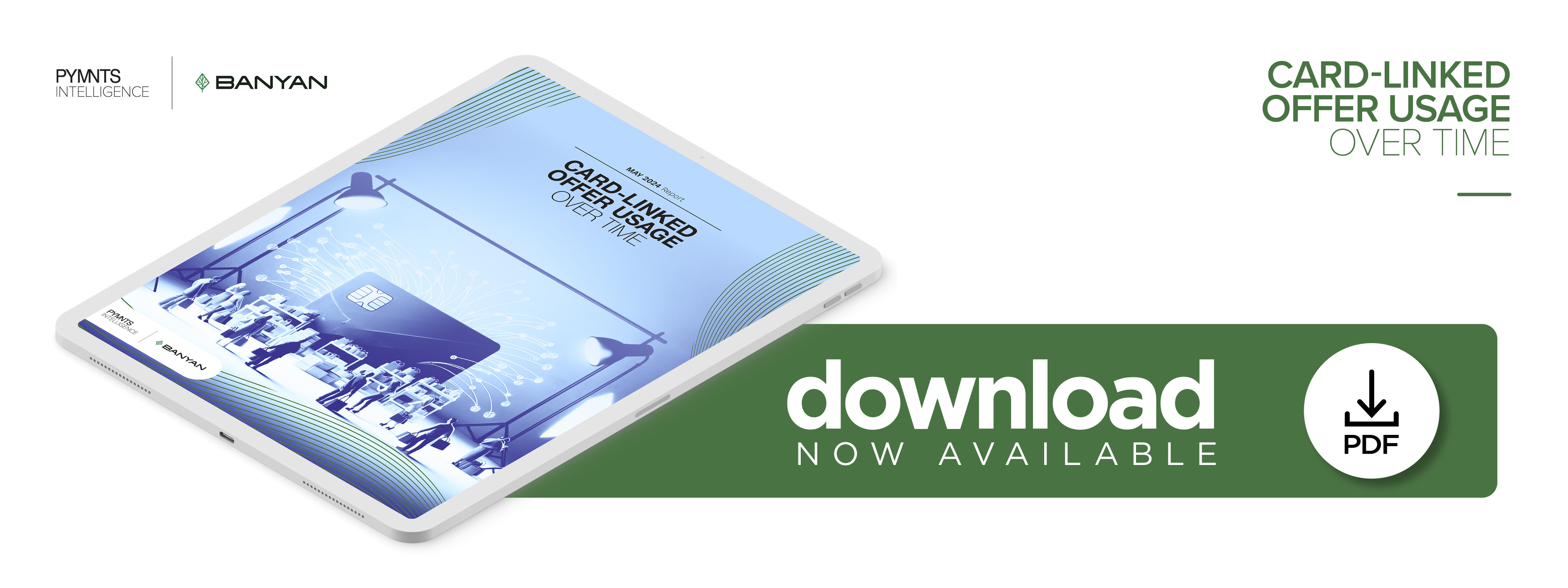
Consumers who use card-linked shopping offers, which provide special savings or rewards attached to a merchant or product, return for more — most do. But what about the 21% of past users who never return? PYMNTS Intelligence finds that if those who used these offers in the past came back, more than half of U.S. cardholders would be users. What do these consumers say keeps them from returning to card-linked offers? Irrelevant offers and unappealing deals. But the naysayers should give these offers another look. These are just some of the findings detailed in “Card-Linked Offer Usage Over Time,” a PYMNTS Intelligence and Banyan collaboration. The report examines the future growth dynamics of card-linked offers. It draws on insights from a survey of 2,108 U.S. consumers conducted from March 20 to April 6, exploring how and why they started using these offers. Other key findings in the report include the following. Former users view the lack of relevant offers as the key reason they have not yet returned. Relevancy and savings are key to drawing consumers in. Data shows that for 22% of former users, a lack of relevant offers is not just a deterrent for using cards but the key reason they do not return. These consumers’ perceptions do not match how these offers have changed. Card-linked offers are becoming more attractive in areas consumers care about — relevancy and savings — if only former users would notice. Nearly two-thirds of card-linked offer users are more satisfied with the relevancy of the offers they received this year than the previous year. Current users are noticing more improvements in their offer programs. But the same is not true for former users, who remain outside of the programs. Providers that target past users and position how the programs have improved could have a competitive advantage. More than half of past users are at least somewhat likely to use the offers again in the future. Most card-linked offer users will likely use them again. However, 63% of cardholders have not received these offers in the last year or noticed if they have. Here, providers have missed out on an opportunity. The report explores which past users are more likely to return. Providers must target consumers who have never used these offers and reengage previous users to grow usage. Download the report to learn more about how card-linked offer providers can deliver a one-two punch to unlock the next wave of growth. The post New Data: Card-Linked Offers Improve Relevance and Value appeared first on PYMNTS.com.
Increased initial public offering (IPO) activity is supporting banks, brokerage firms and law firms within the Dubai International Financial Centre’s (DIF…
Rise in IPOs Could Drive Growth for Capital Markets Across MENA Region, Says DIFC
Servizi bancari
Riepilogo
Increased initial public offering (IPO) activity is supporting banks, brokerage firms and law firms within the Dubai International Financial Centre’s (DIFC) ecosystem, with fees for MENA deals alone exceeding $1.2billion. In a new report, ‘Regional Outlook for Banking and Capital Markets‘, produced by DIFC in partnership with LSEG Data & Analytics, the entities discuss how they expect regional IPO growth to come in three phases: The continued privatisation of state-related entities Listings by family-owned companies Fintech and tech-enabled start-ups DIFC explained that 2024 shows signs of a rebound supported by the postponement of several 2023 deals in anticipation of more favourable market conditions. In 2022, 51 IPOs took place, raising $22billion, according to EY. Privatising state-related entities could lead to greater economic diversification, private sector development and sovereign liquidity creation. By March 2024, Dubai had followed through on six of the 10 government entities it plans to take public, including Parkin, which attracted $71billion in orders. Arif Amiri, CEO of the DIFC Arif Amiri, CEO of the DIFC Authority, said: “Driven by the surge in IPOs, capital markets across the MENA region have experienced remarkable expansion, driven by reforms aimed at enhancing market infrastructure and fostering greater foreign and regional investment inflows. “With its strategic initiatives and robust regulatory framework, DIFC plays a pivotal role in driving innovation and stimulating growth within the financial sector. Dubai’s IPO boom underscores the city’s status as a thriving hub for capital markets, and DIFC’s role in enabling this acceleration through the firms that drive capital markets and provide advisory services for IPOs will continue to contribute to the dynamic evolution of global finance.” IPOs driving business growth From the private sector, listing family-owned companies is helping to drive business growth, succession planning and enhanced governance and transparency. Al Ansari Financial Services, one of the UAE’s largest remittance and foreign currency exchange companies, owned by a local family group raised $210million from its 2023 IPO. DIFC and LSEG believe now is an enticing time for other family businesses to do the same. A third wave of IPOs is expected through fintech and tech-enabled start-up exits, helping to stimulate new industries with high-growth potential, while creating strong demand from investors and viable exit options for VC investors. Proceeds from MENA equity and equity-related deals exceeded £13billion in 2023. The report also highlights how the region’s capital markets are becoming more mature, driven in Dubai by DIFC’s robust regulatory framework and commitment to innovation. DIFC is also home to more than 230 investment banks, all of which are stimulating capital markets. According to recent data, the UAE attracted a record-breaking number of High-Net-Worth Individuals (HNWIs) in 2022, which continued into 2023 and beyond. It also boasts around 109,900 resident HNWIs, including 298 centi-millionaires and 20 billionaires, prompting DIFC’s estimated 370 asset managers to strengthen their regional presence. The post Rise in IPOs Could Drive Growth for Capital Markets Across MENA Region, Says DIFC appeared first on The Fintech Times.